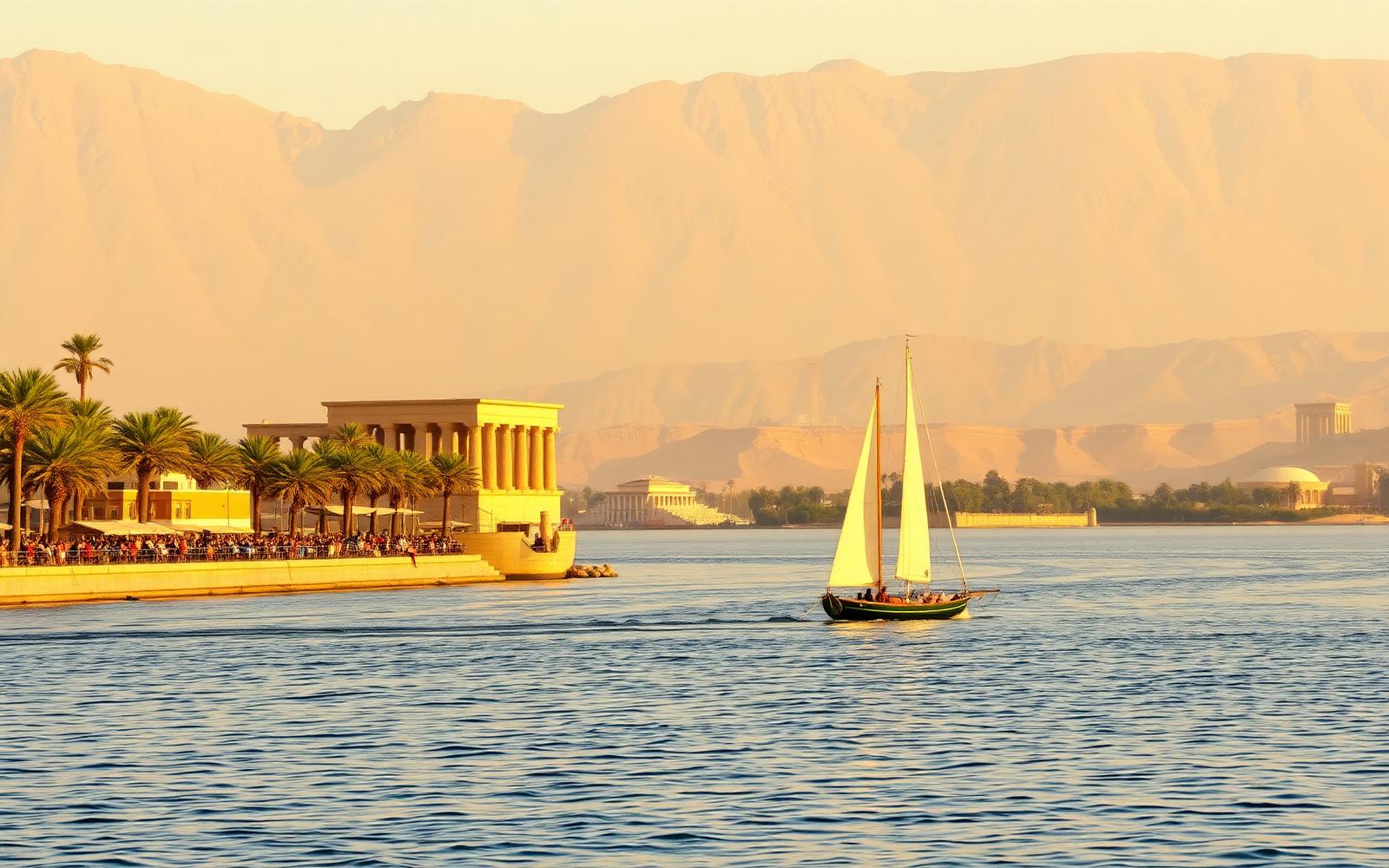
Luxor at sunrise: a felucca on the Nile, the palm-lined East Bank corniche and the desert cliffs of the West Bank beyond

Luxor

A small Nile city built over ancient Thebes and split in two by the river: an urban East Bank of temples, corniche, station and services, and a rural West Bank of tombs, mortuary temples, sugarcane villages and desert cliffs — the densest concentration of ancient Egyptian monuments anywhere, in a place you can cross in twenty minutes.

The verdict

Luxor is strong for the densest ancient Egyptian archaeology anywhere, for early mornings, slow river days and very low prices, and for anyone who wants the monuments within reach instead of an hour across a megacity — and weaker for heat, shade, accessibility, evening life, service depth and anyone hoping for a city.

Two decisions shape your Luxor: which bank you sleep on, and what time you leave the room. Sleeping on the East Bank buys services, food and the station; sleeping on the West Bank buys silence and the tombs at opening time. Either way, the day is won or lost before ten in the morning.

Strong for

  • The Valley of the Kings and the West Bank mortuary temples
  • Karnak and Luxor Temple, both reachable on foot or in minutes
  • Early risers who want a site at opening time
  • Slow Nile days, feluccas, ferries and village mornings
  • Low prices, especially over a week or more
  • A winter-season base for a long, quiet stay

Weaker for

  • Any visit between June and September
  • Reduced mobility, prams or step-free sightseeing
  • Travellers who want restaurants, nightlife and choice
  • Anyone unwilling to negotiate prices constantly
  • A stay of months without a plan for the summer
  • Visitors who dislike early starts

What Luxor actually is

Environment
A narrow green ribbon of palms and sugarcane along the Nile with bare desert cliffs immediately behind: the built town and its temples on the East Bank, and fields, villages, mortuary temples and dry royal valleys on the West.
Energy
Small-town and early: activity at dawn and again after sunset, an empty middle of the day, evenings on the corniche, and very little noise, choice or nightlife by any city standard.
Purpose
Ancient Thebes: the royal tombs, the mortuary temples, Karnak and Luxor Temple and two good museums — plus the Nile itself, and excursions to Dendera, Abydos or onward to Aswan.
Reality
Heat organises everything, the river splits the town into two different transport decisions, tickets are fragmented and sold separately, selling pressure around the sites is constant, and outside the archaeology and the Nile this is a small provincial town with thin services.

What are you here for?

A trip with a return date: one bank chosen deliberately, tombs and temples at opening time, museums or a pool in the afternoon, and the corniche after dark.

How long?

3 days

Your exact figure is kept as entered — never rounded or grouped into a band.

Examples:

What that costs

Estimated total for 3 days

Budget

$70 – $140

Mid-range

$193 – $385

Premium

$595 – $1,400

Priced using the daily pattern.

Visitor costs: per person, per day, on the ground — accommodation on shared or double-occupancy assumptions where appropriate, food, river crossings and local transport, site tickets and ordinary activities. The first two days include a short-stay and arrival premium: the transfer, the first-night room rate and the tickets and driver a two-day monument sprint front-loads.

Visitor bands assume roughly US$20–40 a day on a budget, US$55–110 mid-range and US$170–400 premium, per person — slightly below Cairo, because rooms and food are cheaper, and above it on the days you buy several tickets and a driver. Site tickets dominate: a general Valley of the Kings ticket covers only a few tombs, premium tombs are ticketed separately, each temple has its own entry, and a West Bank day with a car and a guide can exceed the room. Anchors, not promises, and not a currency-rate forecast.

Excludes international airfare, visas and paperwork, insurance, personal shopping and anything personal. Planning estimates only — never a live quote, an availability claim or an exchange-rate guarantee.

Who it suits

  • Archaeology travellers who want depth over breadth
  • Early risers happy to finish sightseeing by late morning
  • Slow travellers staying a week or more
  • Anyone on a Nile route between Cairo and Aswan
  • Photographers working with dawn and dusk light
  • Winter-season long-stayers on a small budget

Who it may not suit

  • Travellers who can only come between June and September
  • Anyone needing step-free access at the monuments
  • Families with young children on a monument-heavy plan
  • Travellers who want restaurants, bars and variety
  • Anyone who finds constant negotiation exhausting
  • Long-stayers who need city-grade medical or work services

Why people travel to Luxor

  • The Valley of the Kings and its painted royal tombs
  • Karnak at opening time, before the coaches
  • Luxor Temple lit after dark in the middle of town
  • Deir el-Bahari, Medinet Habu and the Ramesseum
  • The public ferry, a felucca and the river at sunset
  • West Bank villages, fields and the Theban cliffs at dawn
  • Dendera or Abydos as a long day for a longer stay

Timing and seasonality

Luxor has a short comfortable season and a long severe one, and the difference is not a matter of preference. November to February is the season: warm days, genuinely cold desert nights, full hotels and the highest prices of the year. October and March are hot but workable if you finish early. April and May climb fast. June to September is extreme dry heat — regularly among the hottest inhabited places in the country — in which the West Bank is realistically a dawn-only proposition, midday sightseeing is unsafe rather than merely unpleasant, many places cut hours or close, and rooms fall to their lowest rates for exactly that reason. Whenever you come, the plan is the same: be at the gate when it opens, carry more water than you think you need, cover your head, and treat the middle of the day as indoor time. Ramadan moves each year and changes daytime hours and food.

Across the twelve months

November – February
The season: comfortable days for walking the sites, cold nights that surprise people who packed only for the desert, full hotels and the year's highest room rates. Book the sites for opening time — this is also when the coaches and cruises arrive.
March & October
The shoulders: hot by late morning but entirely workable with an early start, with lower prices and thinner crowds. March can also bring khamaseen dust winds that grey out the sky and the cliffs.
April – May
Climbing fast towards the summer. Sightseeing still works before about 10:00 and becomes punishing after it; a hotel with shade or a pool stops being a luxury and becomes part of the plan.
June – September
The severe months: extreme dry heat with no shade in the valleys, dawn-only outdoor time, reduced opening hours in places, and the cheapest rooms of the year. Travel here in these months only with a strict early timetable and real caution about heat.

How Luxor changes through the day and week

A typical day
The day is built around the sun, not around opening hours: leave before the sites open, spend the first two hours where the tickets are, be back across the river or under shade by late morning, use the museums, a pool or a long lunch through the worst of the afternoon, and take the corniche, the temple lighting or a felucca after sunset.
Weekdays
The working week runs Sunday to Thursday, but for a visitor the calendar matters far less than the arrival of coaches and Nile cruises: the same Tuesday morning at Karnak can be empty at opening and full an hour later.
Weekends and holidays
Friday and Saturday are the local weekend, and Friday around midday prayers is the quietest the town gets. Weekend evenings bring families out to the corniche and the ferry, and the ferry itself is busiest at the start and end of the working day.

These are rhythms of the day and week — they are not trip lengths, and they do not change with how long you stay.

What changes when you stay longer

From a month
From a month, Luxor stops being a monument sprint: monthly rent on a flat or a West Bank house instead of nightly rooms, a bicycle or motorbike instead of hired drivers, the public ferry as ordinary transport, the local market instead of restaurants, an electricity bill dominated by summer cooling, internet, gas and water, and health cover. The sites become an occasional morning rather than the budget, and the real question becomes what you do with the afternoons.
From a year
From a year, the lease and the summer dominate: a deposit and any agency fee at signing, furnishing and repairing an older building, residence and visa renewals, private health cover and the trips to Cairo that serious care or paperwork can require, a brutal summer electricity peak, and a decision many long-stayers make explicitly — whether to leave for the hottest months at all. These are planning cautions, not legal, tax, immigration or tenancy advice; verify current requirements yourself.

Getting around and getting there

Luxor has no metro and no meaningful public transport beyond minibuses and the river. The East Bank centre is genuinely walkable — Luxor Temple, the museums, the souk and the corniche are a stroll apart — and Karnak is a very cheap taxi or a calèche north. The West Bank is a different decision: you reach it by the frequent public ferry or by the road bridge some kilometres south, and once there the sites are kilometres apart in open desert, so you need a bicycle, a motorbike, a taxi or a driver for the day, and a plan for getting back after the ferry's last useful crossing. Arrival is easy by Egyptian standards: the airport is fifteen to twenty-five minutes east with roughly hourly-scale domestic links to Cairo, and the railway station sits in the middle of town with day and overnight trains north and to Aswan. Accessibility is the weak point everywhere — sand, steps, steep tomb descents, uneven temple floors and gangway boarding on the ferry.

Luxor International Airport is about fifteen to twenty-five minutes east of the centre and handles domestic flights from Cairo — roughly an hour — alongside seasonal international services. The railway station sits in the middle of the East Bank, with day and overnight trains to Cairo, and Aswan is three to four hours south by rail or a common Nile cruise leg. Within the city, the river itself is a transport link: the public ferry runs frequently and cheaply, and the road bridge is the alternative when it does not.

Where to base yourself

East Bank corniche & Luxor Temple

The heart of the town: the river on one side, Luxor Temple lit at night on the other, hotels, cafés, the souk a street inland and the corniche walk that carries the whole evening.

Walkable to Luxor Temple and the museum, a short taxi or calèche to Karnak, and the public ferry to the West Bank leaves from here.

Best for: a first visit of two to four days. Strength: everything on the East Bank on foot, the ferry at the door, and the widest choice of food and rooms. Watch out for: the most persistent selling in town, higher prices than anywhere else in Luxor, and traffic noise on the corniche itself.

North East Bank — around Karnak

Ordinary residential Luxor stretching north from the centre towards the Karnak complex: local shops, fewer visitors and a plainer, cheaper version of the same town.

Twenty to forty minutes on foot into the centre, or a very cheap taxi; Karnak is close enough to reach at opening time before the coaches arrive.

Best for: longer stays and tighter budgets. Strength: local prices, quiet nights and an early Karnak. Watch out for: little to do in the evening, more walking in the heat, and no river view.

West Bank villages

Mudbrick and concrete villages among sugarcane and alfalfa under the Theban cliffs, with guesthouses, donkeys, tractors, roosters at dawn and the mortuary temples at the end of the lane.

Reached by the public ferry or the road bridge some kilometres south; once there you need a bicycle, a motorbike, a taxi or a hired driver, and crossing back after dark depends on the ferry timetable.

Best for: a week or more, and for anyone who wants the tombs at opening time. Strength: silence, the cliffs, sunrise over the river, low rents and a village that is a place rather than a stop. Watch out for: it is not simply another walkable neighbourhood — every meal out, every museum and every late evening becomes a river crossing, and services are thin.

Riverside hotels & the southern strip

Larger hotels with gardens, pools and river frontage, mostly strung south of the centre and along the corniche, sold as a comfortable base rather than a neighbourhood.

Taxis or hotel transport for everything; the centre is a short ride, and the airport is fifteen to twenty-five minutes east.

Best for: families, hot months and travellers who need a pool and shade in the middle of the day. Strength: comfort, step-free rooms and somewhere to be at 14:00 in May. Watch out for: prices several times the local rate, an isolated stay, and very little contact with the town.

Honest trade-offs

  • The bank that gives you silence takes away your services, and the reverse.
  • The cheapest months are cheap because the outdoors is closed to you.
  • Everything worth seeing is close, and almost nothing is shaded.
  • A monument sprint sees more and remembers less.
  • Arranging drivers and tickets yourself is far cheaper and far more friction.
  • A week costs little more than three days and delivers a different place.
  • The town is small enough to know quickly, and to exhaust just as quickly.
  • Heat and sun exposure are the central constraint. The tombs and temples are open stone with almost no shade, summer is severe, and a plan that ignores an opening-time start simply does not work — hydration, hats and an early finish are not optional here.
  • The river split is a real cost, not a detail. Sleeping on one bank means ferry or bridge legs for everything on the other, the ferry has hours, and the West Bank is not simply another walkable neighbourhood — it is fields and desert with kilometres between sites.
  • Ticketing is fragmented and easy to get wrong: a general valley ticket that covers only a few tombs, separate premium tombs, a separate ticket for each temple, photography rules that vary, and offices that are not always where the site is.
  • Tourism is the town's main industry, so offers of taxis, feluccas, calèches and souvenirs are constant around the sites and the corniche, and prices are negotiated rather than posted. It is a market condition to prepare for, not a judgement about the people who live here.
  • Beyond the archaeology and the river, Luxor is a small provincial town: limited restaurants, little nightlife, thin medical and shopping options, and evenings that end early. What is a virtue for three days can be confining over a month.
  • Monument fatigue arrives fast. Painted chambers begin to blur after the third or fourth tomb in one hot morning, and families with young children reach that point much sooner — two well-chosen sites usually beat five.
  • Step-free access is limited almost everywhere: sand and ramps of loose ground at the valleys, steep descents into tombs, uneven temple floors, ferry boarding over a gangway and few adapted vehicles. Plan the day around a private driver and expect to skip some tombs.

If Luxor is not right

A short list of relevant places in Egypt, not a complete inventory of the country. Cards without a page are previews, not links. Places outside Egypt are listed separately and labelled with their own country.

Aswan

City — EgyptPreview only

You gain: Three to four hours south: Nubian villages, granite islands, the calmest river in the country and warmer winter air.

You give up: The sheer density of monuments — nothing matches the West Bank of Luxor.

Alexandria

City — EgyptPreview only

You gain: Sea air, a Mediterranean climate and a summer you can actually spend outdoors.

You give up: Pharaonic archaeology almost entirely, and the desert light that defines Upper Egypt.

Edfu and Kom Ombo

Nile temple towns — EgyptPreview only

You gain: Two well-preserved temples between Luxor and Aswan, usually taken as cruise stops or a long day by road.

You give up: Any reason to stay overnight — these are stops, not bases.

Hurghada

Red Sea resort town — EgyptPreview only

You gain: Four hours east by road: sea, diving, shade and an undemanding week after the tombs.

You give up: History, the Nile and any sense of Egypt beyond the resort strip.

Similar places in Egypt

Explore more places in Egypt

Looking beyond Egypt?

These are outside Egypt. Each one is labelled with its own country; those without a page are shown as previews only.

  • Bali Indonesia · IslandPreview onlyIsland living with a bigger long-stay community — page not built yet.

Sources and freshness

Sourced claims cite Experience Egypt from the Ministry of Tourism and Antiquities, the ministry's egymonuments register for the temples, tombs and museums, official Egyptian airport information for Luxor International Airport, Egyptian National Railways for rail links, and the WMO World Weather Information Service carrying Egyptian Meteorological Authority climatological data for heat and dust cautions. Cost anchors use crowd-sourced traveller-spend benchmarks — historical traveller data, not official statistics — and current rental listing benchmarks, which are variable market evidence rather than fixed rates. Everything else is an editorial estimate marked as such in the record. Retrieved and updated August 2026; checked 2026-08-30, due for recheck 2027-08-29.

  • Experience Egypt — Egyptian Ministry of Tourism and Antiquities official destination portal2026-08-30
  • Ministry of Tourism and Antiquities — official museums and archaeological sites register2026-08-30
  • Egyptian Airports Company — Luxor International Airport official information2026-08-30
  • Egyptian National Railways — official passenger rail information2026-08-30
  • WMO World Weather Information Service — Luxor climatological normals supplied by the Egyptian Meteorological Authority2026-08-30
  • Budget Your Trip — Luxor traveller-spend benchmarks (crowd-sourced historical traveller data)2026-08-30
  • Current Luxor rental and monthly-stay listing benchmarks (variable market evidence, not a fixed rate)2026-08-30

Daily ground budget

What one day on the ground costs here, per traveller, with international airfare excluded.