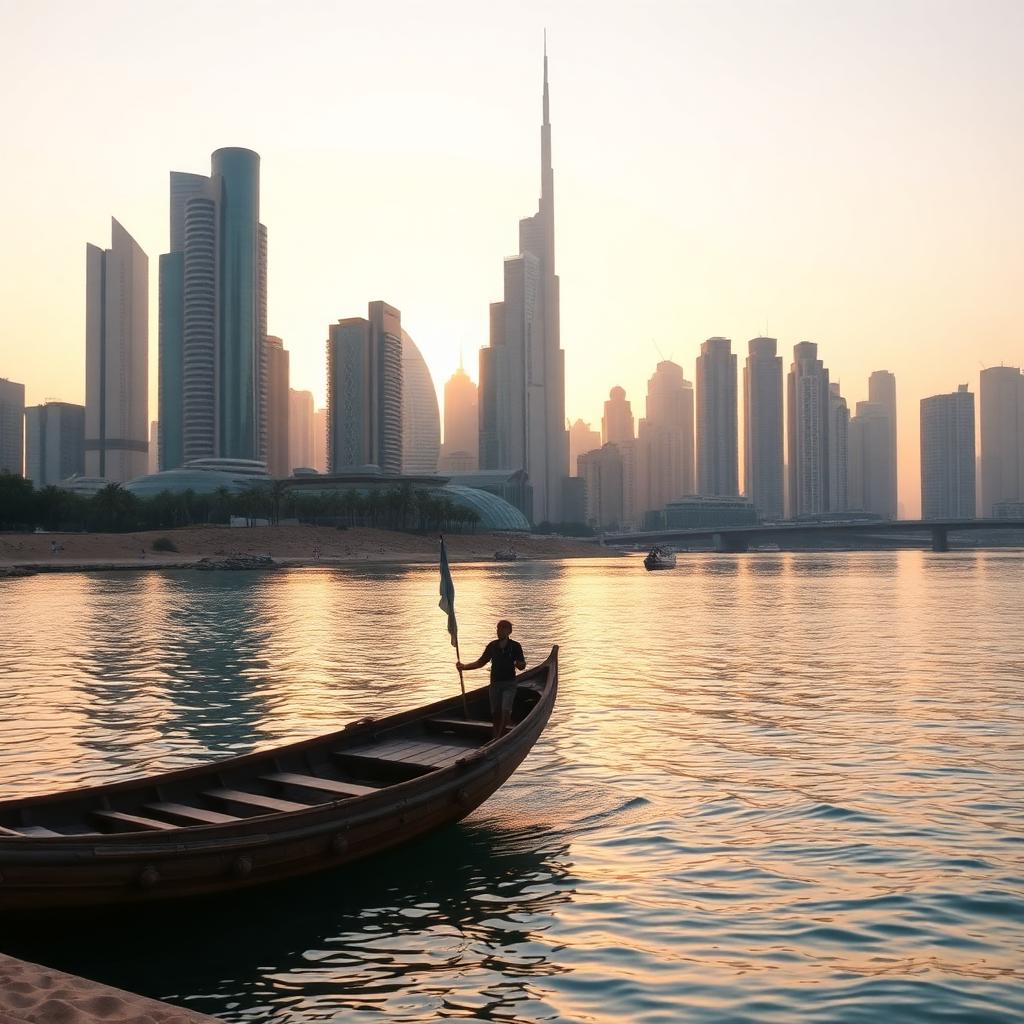
The Dubai skyline at sunset seen from the creek, with a wooden abra boat in the foreground

Dubai

A fast-built coastal city of roughly 3.8 million people on the edge of the desert, where most residents are long-stay expatriates — a long strip of towers, beaches and malls along the Gulf, stitched together by one metro line spine, wide highways and short taxi rides rather than by walking.

The verdict

Dubai is strong for a warm, dry winter by the sea, easy arrival and onward flights, safety, service, family logistics and a long-stay base with year-round infrastructure — and weaker for walking between districts, summer comfort, old-city character, low transport costs and anyone whose budget cannot absorb a beach-and-brunch version of the city.

Two numbers decide your Dubai: the month you come, and how much of the city you pay to enter. A winter week on public beaches, the metro and supermarket food is a different trip — and a different price — from the same week of beach clubs, brunches and taxis, in the same city.

Strong for

  • A warm, dry sea season from about November to March
  • Arriving easily, and flying onward almost anywhere
  • Families, with short distances by car and everything indoors
  • Service, safety and reliable everyday infrastructure
  • A long-stay base for remote work and business setup
  • Desert, mountain and neighbouring-emirate day trips

Weaker for

  • Walking between districts, or a car-free month
  • Any outdoor plan from about May to September
  • Old streets, layered history and unplanned atmosphere
  • Cheap winter rooms around the holiday peak
  • Budgets that follow the marketed version of the city
  • Travellers who want nature within walking distance

What Dubai actually is

Environment
A flat desert coast on the Gulf: a saltwater creek through the old districts, a near-continuous line of towers along the shore, and villa neighbourhoods, highways and open sand immediately behind them.
Energy
Late and indoor-led: conventional office hours, but shopping, dining and family life running into the night, with malls and hotels acting as the public space whenever it is too hot outside.
Purpose
Winter sun and warm sea; large-scale attractions, shopping and dining; a hub for onward flights and stopovers; desert and mountain days; and a working base for remote work, business and family relocation.
Reality
A severe summer, long distances that make walking impractical, a very wide gap between the cheap and expensive versions of the same day, rents agreed by the year, and conduct and medication rules stricter than many visitors expect.

What are you here for?

A trip with a return date: one base near the metro, beach mornings, indoor afternoons, a desert day and late evenings.

How long?

3 days

Your exact figure is kept as entered — never rounded or grouped into a band.

Examples:

What that costs

Estimated total for 3 days

Budget

$204 – $374

Mid-range

$510 – $952

Premium

$1,360 – $3,230

Priced using the daily pattern.

Visitor costs: per person, per day, on the ground — accommodation on shared or double-occupancy assumptions where appropriate, food, local transport and ordinary activities. The first two days include a short-stay and arrival premium, mostly the airport transfer and the first-night room rate.

Visitor bands assume roughly US$60–110 a day on a budget, US$150–280 mid-range and US$400–950 premium, per person — comparable to Tokyo at the middle, far above Bangkok and Chiang Mai, and reachable at the bottom only on public beaches, the metro and supermarket food. Beach clubs, brunches, licensed drinks, paid attractions and winter-peak room rates push totals well above the top of these bands. Anchors, not promises, and not a currency-rate forecast.

Excludes international airfare, visas and paperwork, insurance, personal shopping and anything personal. Planning estimates only — never a live quote, an availability claim or an exchange-rate guarantee.

Who it suits

  • Winter-sun travellers who want a warm, dry, reliable sea
  • Families who value short drives, safety and indoor options
  • Stopover travellers with one to three days between flights
  • Remote workers and long-stayers who want infrastructure first
  • GCC travellers making a short, easy regional trip

Who it may not suit

  • Anyone travelling car-free who wants to walk everywhere
  • Travellers who cannot avoid the May-to-September months
  • History and old-town travellers looking for depth
  • Backpacker budgets expecting Southeast Asian prices
  • Anyone wanting nature and quiet on the doorstep

Why people travel to Dubai

  • A warm, swimmable sea through the whole winter
  • Public beaches that cost nothing and are well kept
  • One of the world's largest flight networks on the doorstep
  • The creek, the souks and abra crossings in old Dubai
  • Desert dunes and the Hajar mountains within a day
  • A dining scene that spans every price level and cuisine

Timing and seasonality

The year has one long comfortable season and one severe one. November to March is warm, dry and the reason most people come — and the winter holiday weeks are the busiest and most expensive of the year. April and October are transitional: hot but usable, with better prices. Roughly May to September brings extreme heat with coastal humidity, warm nights, occasional dust and the cheapest rooms of the year — a workable trip only if you accept an indoor, early-morning and after-dark timetable. Ramadan moves each year and changes daytime hours, dining and the feel of the city; check the dates before booking.

Across the twelve months

November – February
The peak: warm days, cool evenings, a swimmable sea and every outdoor venue open. Room rates are at their highest around the winter holidays and major events, and popular restaurants need booking.
March – April
Still comfortable in March and increasingly hot through April, with the sea at its most pleasant and prices easing as the season ends. Dust and wind are more common in spring.
May – September
Extreme heat with coastal humidity and warm nights. Outdoor time works only very early or late, the sea itself becomes uncomfortably warm at the peak of it, and room rates fall to the year's lowest. Indoor plans, hotel pools and shorter days outside are the only realistic shape for a trip.
October
The turn of the season: still hot early in the month, noticeably easier by the end of it, with prices below the winter peak and the city reopening outdoors.

How Dubai changes through the day and week

A typical day
The day splits around the heat rather than around opening hours: beach and outdoor time before roughly 10:00 and again after sunset, air-conditioned space in between. Malls, restaurants and attractions stay open late, and traffic peaks in the morning and again between about 17:00 and 20:00.
Weekdays
The working week runs Monday to Friday and the weekend falls on Saturday and Sunday. Weekday mornings are the calmest time at the big attractions, and Friday afternoons are quieter around prayer time.
Weekends and holidays
Friday and Saturday evenings are the busiest of the week: beaches, malls, restaurants and the fountain crowds all fill, and popular places need a booking. Public holidays and major events lift both prices and traffic.

These are rhythms of the day and week — they are not trip lengths, and they do not change with how long you stay.

What changes when you stay longer

From a month
From a month, the decisions change: which community you actually live in and how far it is from a metro station, a Nol card versus running a car with fuel, tolls, parking and insurance, groceries and cooking instead of eating out, an electricity bill dominated by cooling through the summer, internet and a phone line, laundry, and health cover. Whether you have children, and where they would go to school, changes the shape of the whole budget.
From a year
From a year, the lease and the paperwork dominate: an annual contract with a security deposit, agency commission, housing fee and a small number of cheques upfront, furnishing an unfurnished apartment, residence and medical paperwork with renewals, health insurance, a summer utility peak, school fees where children are involved, and flights home. These are planning cautions, not legal, tax, immigration or tenancy advice — verify current requirements yourself.

Getting around and getting there

Dubai is a driving city with one strong metro spine. Two automated metro lines, a marina tram, buses, water buses and the creek abras cover a great deal, and a rechargeable Nol card works across all of them — but many destinations sit off the network, and in summer even a five-minute connecting walk is unpleasant. Metered taxis and ride-hailing are plentiful and moderately priced; most residents run a car, where fuel is cheap and tolls, parking and insurance are the real costs. Step-free access is generally good in the newer city: metro stations, malls and hotels are built for it, and the old creek districts are the exception rather than the rule.

Dubai International is one of the world's busiest international airports and sits about fifteen minutes from the old centre, with a second airport at Al Maktoum to the south. Direct flights reach most of Europe, Africa and Asia, and the wider Gulf is one to two hours away, which is why the city is often used as a base or a stopover rather than a single destination.

Where to base yourself

Downtown & Business Bay

The postcard centre: the tallest towers, the largest mall, fountain crowds every evening and a dense band of hotels and offices around them.

On the metro's red line with frequent taxis, and short drives to most of the city outside rush hour.

Best for: a first visit that wants the landmarks on the doorstep. Strength: metro access, everything open late and a genuinely walkable pocket. Watch out for: the highest room rates, heavy evening traffic and no real beach without a drive.

Dubai Marina & JBR

A tower canyon around a man-made marina with a beach promenade beside it — restaurants, boats, joggers and a holiday feel that runs late.

Metro and tram at the edges, walkable inside, and roughly twenty-five to forty minutes to the airport depending on traffic.

Best for: beach mornings and evenings out without a car. Strength: the walk-to-sand convenience and a wide dining choice. Watch out for: the farthest point from the old city and the airport, and dense high-rise living with real traffic at peaks.

Deira & Bur Dubai — the creek

The older, denser, cheaper city: souks, wooden abra crossings, small hotels and the most genuinely walkable streets in Dubai.

Two metro lines, plentiful buses and abras, and the shortest ride to the airport of any central area.

Best for: real prices, street food and a city that exists at eye level. Strength: value, transport and history. Watch out for: crowded, older buildings, limited beach access and much less of the polished Dubai people arrive expecting.

Jumeirah & the beach strip

Low-rise villas, public beaches, resort compounds and quiet residential streets between the shore and the main road.

Away from the metro, so a car, taxi or hotel shuttle is effectively required for daily movement.

Best for: families and beach-led trips that do not mind driving. Strength: space, sea access and calm evenings. Watch out for: dependence on cars, resort pricing and very little to walk to after dark.

Al Barsha & Barsha Heights

Ordinary working Dubai in the middle of the map: apartment blocks, supermarkets, clinics, a large mall and everyday restaurants.

On or near the metro's red line, roughly fifteen to twenty-five minutes from both the marina and downtown outside peak hours.

Best for: a month or longer at ordinary prices with metro access. Strength: value, central position and everyday services. Watch out for: no beach, no atmosphere and a view of the highway.

JVC, Silicon Oasis & the outer communities

Newer planned neighbourhoods away from the shore: mid-rise apartments, townhouses, community parks and supermarkets, still filling in.

Off the metro network: a car is close to essential, and rush-hour journeys to the coast are long.

Best for: annual leases and family space at the lowest rents. Strength: floor area and quiet for the money. Watch out for: car dependence, commuting time and ongoing construction around new buildings.
Honest trade-offs

  • The season that makes Dubai comfortable is the season everyone books.
  • Cheap summer rates are cheap because the outdoors is closed to you.
  • Staying on the beach strip costs the most and puts you farthest from the airport and the old city.
  • The cheapest, most walkable districts are the least polished ones.
  • Skipping a car saves money and costs you time and reach.
  • A long stay is cheaper per month and demands far more cash upfront.
  • Everything is easy here, and very little of it is old.
  • Roughly May to September is a genuine constraint, not a discomfort: high heat with coastal humidity, warm nights, and outdoor plans compressed into the early morning and late evening — which is exactly why rooms are cheapest then.
  • Distances are long and the city is not built for walking between districts: anything off the metro line means a taxi or a car, and transport is a real, recurring line in both a holiday budget and a monthly one.
  • The spread between a cheap Dubai and an expensive one is enormous, and the expensive version is the one that is marketed: beach clubs, brunches, licensed drinks, resort day passes and paid attractions can multiply a daily figure several times over.
  • Rents move quickly with demand and are usually agreed for a full year, often with a deposit, agency commission and a small number of cheques upfront — so a long stay needs more cash at the start than a monthly figure suggests.
  • Local law is stricter than many visitors expect on public conduct, photography of people, alcohol licensing and drinking in public, and on medicines that are ordinary elsewhere but controlled here — check your own prescriptions before flying.
  • Most of the city is recent and planned, so travellers looking for old streets, layered history or an unmanaged atmosphere will find it only in a small area around the creek.
  • For families the two decisive numbers are rent and school fees, and both are set by area and by school rather than by lifestyle — they can outweigh every other item in a monthly budget.

If Dubai is not right

A short list of relevant places in the UAE and the immediate Gulf, not a complete inventory of the region. Cards without a page are previews, not links. Places outside the country are listed separately and labelled with their own country.

Abu Dhabi

CityPreview only

You gain: The same climate and services with more space, lower rents and far fewer crowds, about ninety minutes away.

You give up: Dubai's density of flights, restaurants, nightlife and things simply happening.

Sharjah

CityPreview only

You gain: Markedly cheaper rents and a more traditional, family-oriented city right on Dubai's edge, with strong museums.

You give up: A heavy daily commute into Dubai, a dry emirate with no alcohol licensing, and far fewer beach and dining options.

Ras Al Khaimah

Emirate — beaches and mountainsPreview only

You gain: Beaches, dunes and the highest mountains in the country at lower prices, about an hour north.

You give up: City services, transport frequency and almost everything that happens after dark.

Hatta

Mountain townPreview only

You gain: Cooler mountain air, a reservoir, hiking and quiet, still inside Dubai and reachable in about ninety minutes.

You give up: The sea, the choice and any sense of a city — it is a weekend, not a base.

Doha

City — QatarPreview only

You gain: A smaller, calmer Gulf capital with a similar winter season, a compact centre and strong museums.

You give up: Dubai's scale, flight network, beach strip and sheer range of everyday choice.

Similar places in United Arab Emirates

Explore more places in United Arab Emirates

Looking beyond United Arab Emirates?

These are outside United Arab Emirates. Each one is labelled with its own country; those without a page are shown as previews only.

  • Bali Indonesia · IslandPreview onlyIsland living with a bigger long-stay community — page not built yet.

Sources and freshness

Sourced claims cite Visit Dubai from the Department of Economy and Tourism, the Roads and Transport Authority for the metro, tram, bus, marine and Nol network, Dubai Airports for arrival access, the UAE National Center of Meteorology for heat, humidity and dust cautions, and the official UAE government portal for the working week, residency and conduct rules. Cost anchors use Budget Your Trip's Dubai traveller-spend benchmarks — crowd-sourced historical traveller data, not official statistics — and current rental listing benchmarks, which are variable market evidence rather than fixed rates. Everything else is an editorial estimate marked as such in the record. Retrieved and updated August 2026; checked 2026-08-29, due for recheck 2027-08-29.

  • Visit Dubai — Dubai Department of Economy and Tourism official city guide2026-08-30
  • Roads and Transport Authority (RTA) Dubai — official metro, tram, bus, marine and Nol information2026-08-30
  • Dubai Airports — official passenger and access information for DXB and DWC2026-08-30
  • UAE National Center of Meteorology — climate, heat and dust warning information2026-08-30
  • The Official Portal of the UAE Government — working week, residency, conduct and regulation information2026-08-30
  • Budget Your Trip — Dubai traveller-spend benchmarks (crowd-sourced historical traveller data)2026-08-30
  • Current Dubai rental and monthly-stay listing benchmarks (variable market evidence, not a fixed rate)2026-08-30

Daily ground budget

What one day on the ground costs here, per traveller, with international airfare excluded.