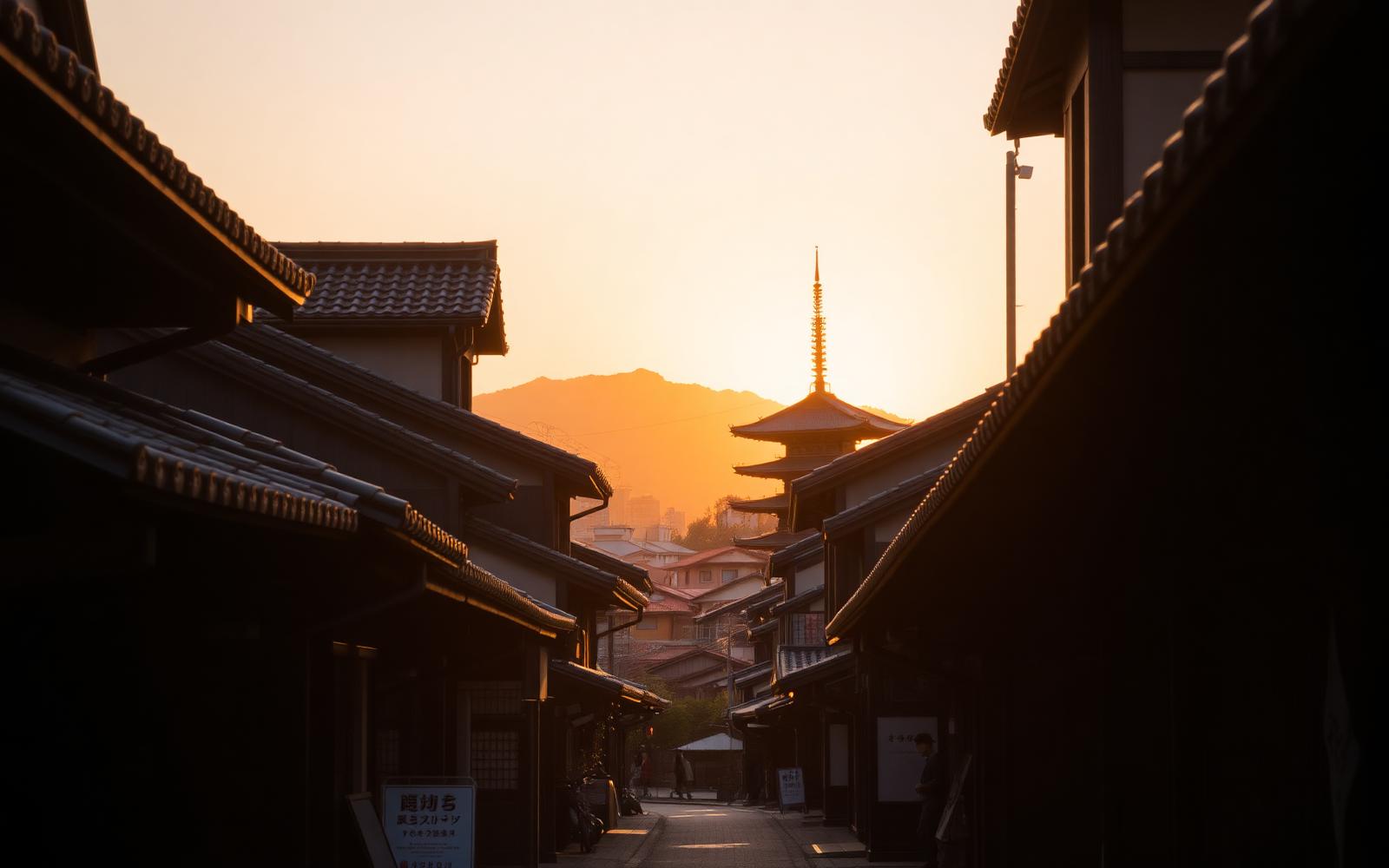
A traditional Kyoto street at dusk with tiled roofs and a pagoda on the hill behind

Kyoto

A working city of about 1.4 million people that also holds Japan's densest concentration of temples, shrines, gardens and preserved streets — flat in the middle, hemmed by wooded hills on three sides, and covered mostly on foot, by bus and by a small number of rail lines.

The verdict

Kyoto is strong for concentrated heritage, gardens, walkable districts, craft and food culture, four real seasons and easy Kansai day trips — and weaker for airport convenience, crowd-free famous sights, step-free travel, late nights, low peak-season prices and a comfortable midsummer.

Your hours decide your Kyoto more than your itinerary does. The same temple before nine in the morning and at two in the afternoon are two different places, and a plan that crosses the city three times by bus will spend the day in traffic.

Strong for

  • The densest concentration of heritage sites in Japan
  • Gardens, temple architecture and preserved streets
  • A flat, genuinely walkable central grid
  • Tea, craft and a distinctive food identity
  • Four distinct seasons, including blossom and autumn colour
  • Day trips to Nara, Osaka, Uji and Lake Biwa

Weaker for

  • Arriving easily — there is no major Kyoto airport
  • Seeing the famous sights without crowds
  • Step-free, low-walking travel
  • Late nights and a broad nightlife spread
  • Low prices in blossom and autumn weeks
  • A dry, comfortable midsummer

What Kyoto actually is

Environment
A low, orderly grid on a flat basin, crossed by the Kamo river and closed in by wooded hills on three sides — temple walls, wooden townhouses and modern concrete on the same street.
Energy
Calmer and earlier than Tokyo: the sights fill from mid-morning and close in the late afternoon, and the evening belongs to a few central streets rather than to the whole city.
Purpose
Heritage, gardens and traditional architecture; tea, craft and kaiseki food culture; walking routes through preserved streets; hill-side hikes; and day trips across Kansai.
Reality
No major airport of its own, crowds concentrated in a few places at the same hours, a bus-dependent network away from the rail lines, a basin that traps summer heat, and a living city where people work behind the postcard walls.

What are you here for?

A trip with a return date: one base, two or three districts walked properly, a Kansai day trip and early mornings.

How long?

3 days

Your exact figure is kept as entered — never rounded or grouped into a band.

Examples:

What that costs

Estimated total for 3 days

Budget

$204 – $357

Mid-range

$476 – $850

Premium

$1,190 – $2,550

Priced using the daily pattern.

Visitor costs: per person, per day, on the ground — accommodation on shared or double-occupancy assumptions where appropriate, food, local transport and ordinary activities. The first two days include a short-stay and arrival premium, mostly the airport rail transfer from Kansai or Itami and the first-night room rate.

Visitor bands assume roughly US$60–105 a day on a budget, US$140–250 mid-range and US$350–750 premium, per person — a little below Tokyo, and well above Bangkok, Chiang Mai and Phuket. Temple and garden entry fees, guided experiences, kaiseki dining and blossom or autumn room rates push totals higher. Anchors, not promises, and not a currency-rate forecast.

Excludes international airfare, visas and paperwork, insurance, personal shopping and anything personal. Planning estimates only — never a live quote, an availability claim or an exchange-rate guarantee.

Who it suits

  • Travellers who want heritage density and will walk for it
  • Couples and solo travellers who like early mornings
  • Anyone using one base for the whole Kansai region
  • Food, tea and craft travellers at any budget level
  • Long-stayers who want a calmer Japanese city than Tokyo

Who it may not suit

  • Anyone who needs a short, simple airport transfer
  • Travellers with reduced mobility on the heritage slopes
  • Beach, tropical-warmth or resort travellers
  • Night-life travellers expecting a capital's spread
  • Budgets that cannot absorb blossom or autumn room rates

Why people travel to Kyoto

  • Temples, shrines and gardens at a density found nowhere else in Japan
  • Preserved wooden streets you can walk between
  • Cherry blossom in spring and colour through November
  • Tea houses, kaiseki, temple cooking and market food
  • Hill trails and river valleys at the city's edges
  • Nara, Osaka, Uji and Lake Biwa within an hour

Timing and seasonality

Two short peaks dominate the year — cherry blossom around late March and early April, and autumn colour through most of November — and both bring the best conditions with the worst prices and crowds. May and early June are warm and much calmer. Late June into mid-July is the rainy season; midsummer is hot and humid in a basin that traps heat, with typhoon risk into September. Winter is cold, dry and quiet, with occasional snow on the hills and a busy New Year period.

Across the twelve months

December – February
Cold, dry and often clear, with the quietest sights of the year and occasional snow on the northern temples. The New Year period closes many businesses for several days and lifts domestic demand.
March – May
The first peak: blossom in late March and early April, then a warm, comfortable May. Bloom dates move every year, and Golden Week from late April into early May fills trains, rooms and temple approaches.
June – September
Rainy season from late June into mid-July, then a hot, humid midsummer that the basin holds onto, with typhoon risk into September. Prices soften outside mid-August, and shaded, indoor and early plans matter more than in any other season.
October – November
The second peak and, for many, the easiest weather of the year: dry, clear and cool, ending in the November colour season. Rooms are booked early and priced accordingly.

How Kyoto changes through the day and week

A typical day
The day is front-loaded. Temples and gardens typically open in the morning and most close in the late afternoon, the famous sites fill roughly between 10:00 and 16:00, and after dark the city narrows to a few central dining streets. Anything you want to see quietly has to happen early.
Weekdays
Weekdays outside holiday periods are noticeably calmer at the major sites, and easier for a seat at lunch. Some museums close on Mondays, and school-trip season fills specific temples on specific mornings.
Weekends and holidays
Weekends and Japanese public holidays fill both the buses and the temple approaches, especially in blossom and autumn weeks. Downtown dining streets are busiest on Friday and Saturday evenings.

These are rhythms of the day and week — they are not trip lengths, and they do not change with how long you stay.

What changes when you stay longer

From a month
From a month, the decisions change: which ward and which line you actually live on, a bus or rail pass instead of single fares, groceries and cooking instead of eating out every meal, laundry, a phone and internet contract, utility bills that swing with winter heating and a humid summer, and how far your street really is from a station rather than a bus stop. Students, families and people on work assignments have very different priorities here.
From a year
From a year, move-in and administrative costs become material: the upfront package a standard lease can require, furnishing an unfurnished flat, health insurance and pension contributions, residence paperwork and renewals, a bank account and phone contract, and seasonal utility peaks. These are planning cautions, not legal, tax or immigration advice — verify current requirements yourself.

Getting around and getting there

Kyoto is a walking city with a small rail skeleton and a large bus network. Two subway lines cross it, JR, Hankyu, Keihan, Kintetsu and the Randen tram cover specific corridors, and buses fill in everything else — slowly, and often full at sightseeing hours. A rechargeable IC card works on almost all of it, bicycles are genuinely useful on the flat central grid, and a car is a burden. The cost of the heritage districts is steps: stone lanes, slopes and temple stairs are constant, and step-free routes exist but are not universal, so plan the route rather than assume it.

Kyoto has no major airport of its own. Most international arrivals come through Kansai International Airport — roughly seventy-five to ninety minutes by direct limited-express train — or Osaka Itami for domestic flights, while the Shinkansen puts Tokyo a little over two hours away.

Where to base yourself

Kyoto Station area

Modern, functional and busy: a very large station complex with hotels, department stores, buses and luggage lockers, rather than an old neighbourhood.

The Shinkansen stop, the direct limited-express link to Kansai Airport, the subway's south end and the origin of most city bus routes.

Best for: arriving with luggage, short trips and day trips to Nara or Osaka. Strength: everything departs from here. Watch out for: a commercial, characterless setting and a bus or subway ride to most of the heritage streets.

Downtown — Kawaramachi & Shijo

The commercial heart: covered shopping arcades, the Nishiki food street, department stores, and the restaurant lanes of Pontocho and Kiyamachi along the river.

Both subway lines and the Hankyu and Keihan railways meet here, and many bus routes pass through.

Best for: a first visit that wants food and walking on the doorstep. Strength: the shortest average trip to everywhere and the most evening options. Watch out for: noise, higher room rates and crowded pavements at weekends.

Gion & Southern Higashiyama

The most preserved side of the city: wooden teahouse streets, stone lanes climbing towards Kiyomizu-dera, and temple gates on quiet slopes between them.

Walkable to many major sights, but served mainly by buses rather than by a nearby rail line.

Best for: waking up inside the heritage district and walking before the crowds. Strength: atmosphere no other area matches. Watch out for: heavy daytime crowds, slopes and steps, high prices and poor luggage access on narrow lanes. Residential privacy rules apply on some private streets — read the posted signs.

Arashiyama & the western edge

Riverside and wooded: the bamboo grove, temple gardens, a mountain river with boats, and a village-like main street that empties in the evening.

Reached by JR, the Randen tram or Hankyu, roughly twenty to thirty minutes from the centre depending on the line.

Best for: a calmer, greener base and early or late access to the famous groves. Strength: quiet evenings and nature on foot. Watch out for: a real commute to downtown, very heavy midday visitor numbers and far fewer late dining options.

Nijo & the Imperial Palace area

Central but residential: wide streets, the palace park, offices and everyday shops, with far fewer tourists per block than Higashiyama.

On the subway's east–west line, with a straight run to the station and downtown.

Best for: families and anyone who wants a central location without the crowds. Strength: space, calm and subway access. Watch out for: fewer restaurants open late and less of the postcard atmosphere.

Northern Kyoto — Kitayama & Kamigyo

University and residential Kyoto: supermarkets, ordinary cafés, botanical gardens and long quiet streets, with the hills close behind.

The subway's north end and frequent buses, roughly fifteen to twenty-five minutes from the centre.

Best for: a month or longer at ordinary prices. Strength: value, space and a genuine local routine. Watch out for: a daily commute, fewer English-language services and quiet evenings.

Fushimi & the south

Older working districts with sake breweries, canals and the shrine hillside, cheaper and much less visited after dark.

Two railway lines run north into the city in about ten to fifteen minutes, and south towards Nara.

Best for: lower room rates with fast trains into the centre. Strength: real prices and early access to the shrine paths. Watch out for: a suburban feel, fewer evening options and a train ride for most sights.
Honest trade-offs

  • The heritage that makes Kyoto also brings the crowds to it.
  • Staying inside the postcard districts costs the most and handles luggage the worst.
  • Station-side convenience buys you departures and takes away atmosphere.
  • The calmest hours are the earliest ones, which is the opposite of a slow holiday morning.
  • Blossom and autumn are the best conditions and the worst prices and availability.
  • Cheaper summer rates come with humidity, rain and typhoon risk.
  • No airport of its own keeps the city quieter and makes every arrival longer.
  • Crowding is concentrated, not general: a handful of famous sites absorb most visitors between mid-morning and late afternoon, and a normal-looking day can feel oppressive if your route follows the same list at the same hours.
  • There is no major Kyoto airport: every international arrival includes a train or bus leg from Kansai or Itami, which adds time, cost and luggage handling to both ends of the trip.
  • Many famous places sit away from a rail line, so the bus becomes the default — and buses are slow in traffic, crowded at peak sightseeing hours and awkward with luggage or a pushchair.
  • The basin holds heat: midsummer is hot and humid with limited breeze, June into mid-July is the rainy season, and typhoon activity into September can disrupt trains and flights at short notice.
  • The heritage districts are the least step-free part of the city: stone lanes, slopes and temple stairs are constant, and step-free routes exist but are not universal.
  • Blossom weeks and the November colour season are the best conditions and the worst availability: rooms are booked early and priced high, and the exact blossom dates move every year and cannot be booked with certainty.
  • People live and work in the districts you are walking through: some lanes in Gion are private property with posted photography restrictions, and quiet streets are residential rather than exhibits.
  • English support is good at major sites and thinner elsewhere, and cash, seals, guarantors and paper forms still appear in everyday administration — most visibly when renting or arranging a long stay.

If Kyoto is not right

A short list of relevant Japanese places, not a complete inventory of Japan. Cards without a page are previews, not links. Places outside Japan are listed separately and labelled with their own country.

Tokyo

City

You gain: Scale, rail depth, later nights and a far wider choice of districts, museums and everyday life.

You give up: Kyoto's concentrated heritage, walkable scale and the calm of a smaller city.

Osaka

CityPreview only

You gain: A cheaper, more informal, food-led base half an hour away, with its own airport link and late-night streets.

You give up: Kyoto's temples, gardens and preserved streets on your doorstep.

Nara

CityPreview only

You gain: Older, smaller and much quieter heritage that can be walked in a single unhurried day.

You give up: Range: far fewer restaurants, shops and evening options than Kyoto.

Kanazawa

CityPreview only

You gain: Comparable preserved districts, gardens and craft with a fraction of Kyoto's visitor numbers.

You give up: Kansai's transport density and the ease of reaching Osaka, Nara and Kobe in under an hour.

Kinosaki & the northern coast

Hot-spring town and coastal areaPreview only

You gain: Hot springs, sea air and an unhurried small-town evening within a few hours by train.

You give up: City services, transport frequency and anything open late.

Similar places in Japan

Explore more places in Japan

Looking beyond Japan?

These are outside Japan. Each one is labelled with its own country; those without a page are shown as previews only.

  • Bali Indonesia · IslandPreview onlyIsland living with a bigger long-stay community — page not built yet.

Sources and freshness

Sourced claims cite the Kyoto City Official Travel Guide, the Japan National Tourism Organization, the Japan Meteorological Agency for climate, rainy-season and typhoon cautions, the Kyoto City Transportation Bureau for the subway and bus network, and Kansai Airports for arrival access. Cost anchors use Budget Your Trip's Kyoto traveller-spend benchmarks — crowd-sourced historical traveller data, not official statistics — and current rental listing benchmarks, which are variable market evidence rather than fixed rates. Everything else is an editorial estimate marked as such in the record. Retrieved and updated August 2026; checked 2026-08-29, due for recheck 2027-08-29.

  • Kyoto City Official Travel Guide (kyoto.travel) — Kyoto City Tourism Association2026-08-30
  • Japan National Tourism Organization — official travel information2026-08-30
  • Japan Meteorological Agency — climate, rainy season, typhoon and warning information2026-08-30
  • Kyoto City Transportation Bureau — official subway and city bus network and fare information2026-08-30
  • Kansai Airports — official access information for Kansai International and Osaka Itami2026-08-30
  • Budget Your Trip — Kyoto traveller-spend benchmarks (crowd-sourced historical traveller data)2026-08-30
  • Current Kyoto rental and monthly-stay listing benchmarks (variable market evidence, not a fixed rate)2026-08-30

Daily ground budget

What one day on the ground costs here, per traveller, with international airfare excluded.