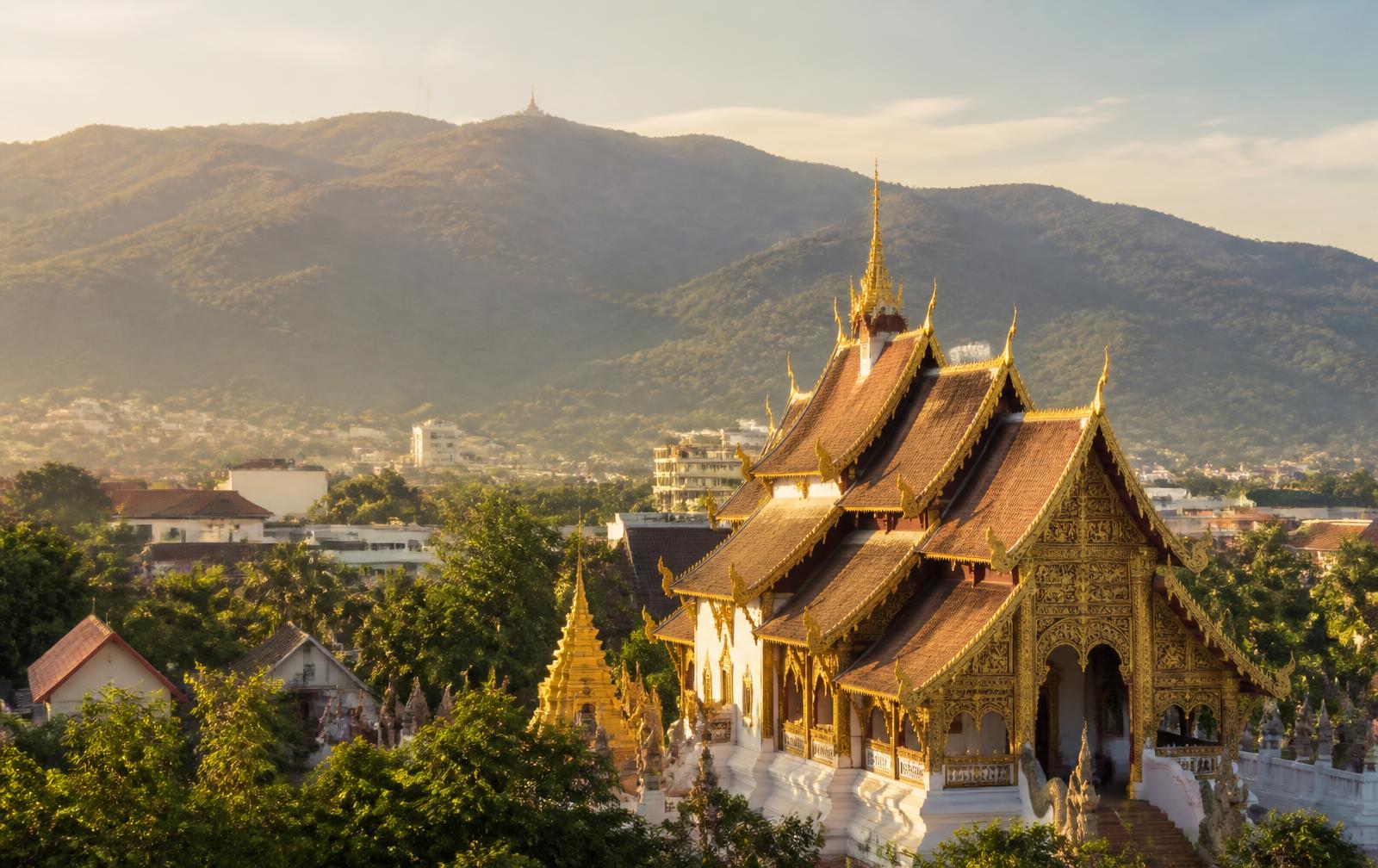
Lanna-style temple in Chiang Mai with the Doi Suthep mountain ridge behind it

Chiang Mai

Northern Thailand's cultural and long-stay base: a lower-rise inland city in a mountain-ringed valley, where Lanna temples, markets, northern food, cafés and creative communities sit within easy reach of forested hills.

The verdict

Chiang Mai is strong for Lanna culture, northern food, markets, cafés and remote work, wellness, mountain access and longer stays — and weaker for beaches, big-city scale, rail-style transit and intense nightlife.

Chiang Mai is easier to settle into than Bangkok, but it is not friction-free. Transport is fragmented outside walkable pockets, and smoke pollution can become severe in the late dry season — often around February to April, varying by year. Check current air quality before you book rather than trusting a fixed window.

Strong for

  • Temples and Lanna heritage in a compact historic core
  • Northern Thai food and market eating
  • Cafés, coworking and remote-work infrastructure
  • Wellness, slower trips and repeat visits
  • Mountain and nature day trips from the city edge
  • Stays of several weeks or months

Weaker for

  • Beaches — there is no coast here
  • Big-city scale and metropolitan variety
  • Rail-style public transport
  • Seamless car-free movement outside your chosen district
  • Intense nightlife
  • Reliably clean air in the late dry season

What Chiang Mai actually is

Environment
An inland northern valley city: a compact historic core inside the old moat, modern districts around it, residential neighbourhoods, and mountains close to the urban edge.
Energy
Calmer and lower-rise than Bangkok, active around food, cafés, markets and evening streets — but not a sleepy village.
Purpose
Culture, food, markets, wellness, remote work, longer stays, nature access and a gentler city base.
Reality check
Rewarding and comparatively affordable, but neighbourhood choice, heat and rain, transport limitations, road safety and seasonal smoke materially change the experience.

Decision guide

Culture, food, markets, wellness, remote work, longer stays, nature access and a gentler city base for northern Thailand.

An inland northern valley city: a compact walled historic core, modern districts around it, quiet residential neighbourhoods, and mountains close to the urban edge.

Rewarding and comparatively affordable, but neighbourhood choice, heat and rain, transport limits, road safety and seasonal smoke materially change the experience.

Choose this if

  • You are travelling solo, couples, friends and families.
  • The pace matches you: Calmer and lower-rise than Bangkok, yet genuinely active around food, cafés, markets and evening streets — a gentler city, not a sleepy village.
  • Your dates fall in January, November and December.

Think twice if

  • Smoke pollution can become severe in the late dry season, and the exact weeks change from year to year — check current air quality before booking rather than trusting a fixed window.
  • Outside a walkable district, movement depends on songthaews, ride-hailing or your own vehicle; car-free life is workable but not seamless.
  • Scooters are common, but they are neither necessary nor risk-free: licensing, insurance validity, helmets and mixed traffic all deserve a decision before you rent one.
  • There is no coast and no big-city scale: beaches and metropolitan variety are a separate trip.
  • Your dates are fixed in March and April, the weakest months on record.

Getting there and getting around

  • Walkability is district-specific, not citywide: songthaews, tuk-tuks, ride-hailing and a limited bus network cover the rest, and there is no Bangkok-style urban rail.
  • An international airport minutes from the centre, with an airport bus service plus long-distance bus and rail links to Bangkok and the north.
  • Walkability: moderate. Public transport: partial.
  • Flight time and airfare depend on the city you actually start from, not on a default origin.

Who this suits

  • Suits solo, couples, friends and families.
  • some walking required
  • workable with children

Worth comparing with

  • For scale, urban rail and big-city variety when Chiang Mai feels too small or too fragmented to move around.
  • A smaller, quieter northern cultural base for travellers who want less tourism density.
  • A small mountain town with a social, backpacker-leaning atmosphere — reached by a long, winding mountain road.
  • For a beach-led trip, which northern Thailand cannot offer at all.
How MTC reached this assessment

This assessment reads the governed record only: decision identity, traveller fit, season values, mobility, recorded drawbacks and the duration-aware cost model (6 cited sources).

Overall confidence recorded for this place: medium. No ratings, reviews or booking inventory are used.

Data last checked: 2026-08-29

Scheduled for recheck after 2027-08-29.

What are you here for?

A trip with a return date: temples, northern food, markets and one or two mountain days.

How long?

3 days

Your exact figure is kept as entered — never rounded or grouped into a band.

Examples:

What that costs

Estimated total for 3 days

Budget

$61 – $102

Mid-range

$153 – $272

Premium

$442 – $816

Priced using the daily pattern.

Visitor costs: per person, per day, on the ground — accommodation, food, local transport and activities. The first two days include a short-stay and arrival premium.

Visitor bands are anchored to Budget Your Trip's 2026 reported Chiang Mai averages — roughly US$22 budget, US$59 mid-range and US$172 luxury per person per day — and widened into honest ranges. Anchors, not promises.

Excludes international airfare, visas and paperwork, insurance, personal shopping and anything personal. Planning estimates only — never a live quote or an availability claim.

Who it suits

  • Travellers who want culture, temples and history at a walking pace
  • Anyone planning their days around northern food and markets
  • Remote workers who need cafés, internet and a routine
  • People staying weeks or months rather than days
  • Travellers who want mountains and nature within a short drive
  • Repeat visitors to Thailand looking for a gentler base

Who it may not suit

  • Anyone whose trip is built around a beach
  • Travellers who expect metro-style transit and car-free ease
  • People who want big-city scale, variety and late nightlife
  • Anyone sensitive to air pollution travelling in the late dry season
  • Visitors unwilling to arrange transport for mountain days

Why travellers come

  • Lanna temples and a walkable layer of northern history.
  • Northern Thai cooking — khao soi, sai ua, sticky rice and market stalls.
  • Markets and crafts, from day markets to weekend walking streets.
  • A café and creative scene with real coworking infrastructure.
  • Wellness: massage, courses, retreats and a slower daily pace.
  • Mountains, waterfalls and forest within a short drive of the city.
  • Festivals that shape whole weeks of the calendar.
  • Costs and rhythms that make a stay of months genuinely workable.

Timing and seasonality

November to January is generally the coolest and most comfortable stretch — and the busiest, with the highest demand. February is a warming transition when smoke risk may begin, varying by year. March and April are the hottest months and carry the highest smoke concern; Songkran is a major event in April, but air quality still has to be checked. May to October is the greener rainy season: hot and humid with showers rather than all-day rain, generally lower demand and better value.

Across the twelve months

November – January
Generally the coolest and most comfortable window, with clear days and cool evenings. Demand and prices are at their highest.
February
A warming transition month. Smoke risk may begin and varies noticeably from year to year — check current readings rather than assuming.
March – April
The hottest period and the highest smoke concern. Songkran in April is a major event, but air quality must be checked before committing.
May – October
The green rainy season: heat, humidity and showers — not continuous rain. Lower demand usually means better value and quieter sights.

How Chiang Mai changes through the day and week

A typical day
Mornings favour temples, markets and being outdoors. Midday heat pushes plans slower or indoors. Cafés, food streets and markets build again through the late afternoon and evening.
Weekdays
University, school and commuter traffic shape a handful of key roads at predictable hours; cafés, coworking and local routines dominate the rest of the day.
Weekends
Walking streets, markets, domestic visitors and mountain routes get much busier — but specific areas change far more than the city as a whole.

What changes when you stay longer

One month or longer
From a month, monthly rent and deposits, utilities, laundry, groceries, a coworking desk, neighbourhood convenience, your transport choice and the timing of smoke season matter far more than tourist attractions.
One year or longer
From a year, immigration and administrative requirements, health insurance, periodic travel, furnishing, healthcare access, road safety and a concrete air-pollution plan all become material. These are planning cautions, not legal advice — verify current requirements yourself.

Getting around

Walkability here is district-specific, not citywide: the Old City, Nimman and Santitham work on foot, while anything between them usually does not. Songthaews, tuk-tuks, ride-hailing and a limited bus network cover the gaps, and there is no Bangkok-style urban rail. Scooters are common, but they are neither necessary nor risk-free — licensing, insurance validity, helmets and mixed traffic are worth a deliberate decision. Mountain day trips usually need organised transport, a driver, or a properly equipped and legal vehicle.

An international airport minutes from the centre, with an airport bus service plus long-distance bus and rail links to Bangkok and the north.

Where to stay

Old City

The square inside the moat: temples every few streets, guesthouses, cafés and the weekend walking streets.

The most walkable part of the city; songthaews and ride-hailing cover anything further out.

Best for: a first, short, temple-led visit on foot. Strength: history at the door with no transport planning. Watch out for: heavy tourist concentration and weekend-market noise.

Nimman (Nimmanhaemin)

Cafés, coworking, modern dining and condo towers, with a steady remote-working and student crowd.

Compact and walkable within itself; the airport and Old City are short rides away.

Best for: working from the city for weeks or months. Strength: the best café and convenience density in Chiang Mai. Watch out for: higher prices, traffic on the main sois and aircraft noise on some approaches.

Santitham

A working local neighbourhood: cheap northern food, small markets, long-term rentals and everyday errands.

Walkable for daily needs, next to Nimman; songthaews and ride-hailing for the rest.

Best for: value on a stay of a month or more. Strength: local prices with Nimman next door. Watch out for: a less polished streetscape and no landmark attractions at the door.

Riverside & Wat Ket

Ping riverbanks, old teak houses, boutique stays, galleries and slower evenings by the water.

A short ride from the Old City; pleasant to walk along the river but not a hub.

Best for: a calmer, atmospheric base. Strength: the prettiest evenings in the city. Watch out for: less efficient for a packed sightseeing plan and fewer cheap eats per street.

Chang Khlan & the Night Bazaar

Hotel blocks, malls and the nightly market corridor between the Old City and the river.

Central and easy to reach, with the most hotel supply in one walkable strip.

Best for: evening access and a straightforward hotel stay. Strength: everything open late in one place. Watch out for: a commercial, tourist-facing feel and traffic on the main road.

Mae Hia & Hang Dong (longer stays)

Suburban and semi-rural south-west of the city: houses with gardens, quieter streets, mountains in view.

Practically vehicle-dependent; ride-hailing exists but journeys into the core are long.

Best for: months at a time with space and quiet. Strength: more room for the money and easy access to the hills. Watch out for: distance from the core and dependence on a vehicle for everything.

Honest trade-offs

  • Genuinely affordable long stays, with late-dry-season smoke as the recurring cost.
  • Compact and walkable inside a district, fragmented between districts.
  • The calm that makes it liveable is the same calm that limits nightlife and scale.
  • The best weather months are also the busiest and most expensive.
  • Mountains are close, but reaching them properly needs transport you have to arrange.
  • Smoke pollution can become severe in the late dry season, and the exact weeks change from year to year — check current air quality before booking rather than trusting a fixed window.
  • Outside a walkable district, movement depends on songthaews, ride-hailing or your own vehicle; car-free life is workable but not seamless.
  • Scooters are common, but they are neither necessary nor risk-free: licensing, insurance validity, helmets and mixed traffic all deserve a decision before you rent one.
  • There is no coast and no big-city scale: beaches and metropolitan variety are a separate trip.

If Chiang Mai is not the fit

  • Bangkok For scale, urban rail and big-city variety.
  • Chiang Rai A smaller, quieter northern cultural base.
  • Pai A small mountain town with a social, backpacker-leaning atmosphere — reached by a long, winding road.
  • Phuket or another southern island For beaches, which northern Thailand cannot offer.

Similar places in Thailand

Explore more places in Thailand

Looking beyond Thailand?

These are outside Thailand. Each one is labelled with its own country; those without a page are shown as previews only.

  • Bali Indonesia · IslandPreview onlyIsland living with a bigger long-stay community — page not built yet.

Sources and freshness

Sourced claims cite the Tourism Authority of Thailand, Chiang Mai Province, Airports of Thailand's Chiang Mai airport bus information, a 2024 Atmospheric Environment study of Chiang Mai PM2.5, and a 2026 Budget Your Trip cost crawl. Everything else is an editorial estimate marked as such in the record. Checked 2026-08-29; due for recheck 2027-08-29.

  • Tourism Authority of Thailand — Chiang Mai2026-08-29
  • Chiang Mai Province — official English site2026-08-29
  • Tourism Authority of Thailand — month-by-month weather guidance (Nov, Feb, Mar, Apr, Jun)2026-08-29
  • Airports of Thailand — Chiang Mai Airport RTC bus service2026-08-29
  • Chansuebsri et al. 2024, Atmospheric Environment — chemical composition and origins of Chiang Mai PM2.52026-08-29
  • Budget Your Trip — Chiang Mai travel costs (2026 crawl)2026-08-29

Daily ground budget

What one day on the ground costs here, per traveller, with international airfare excluded.