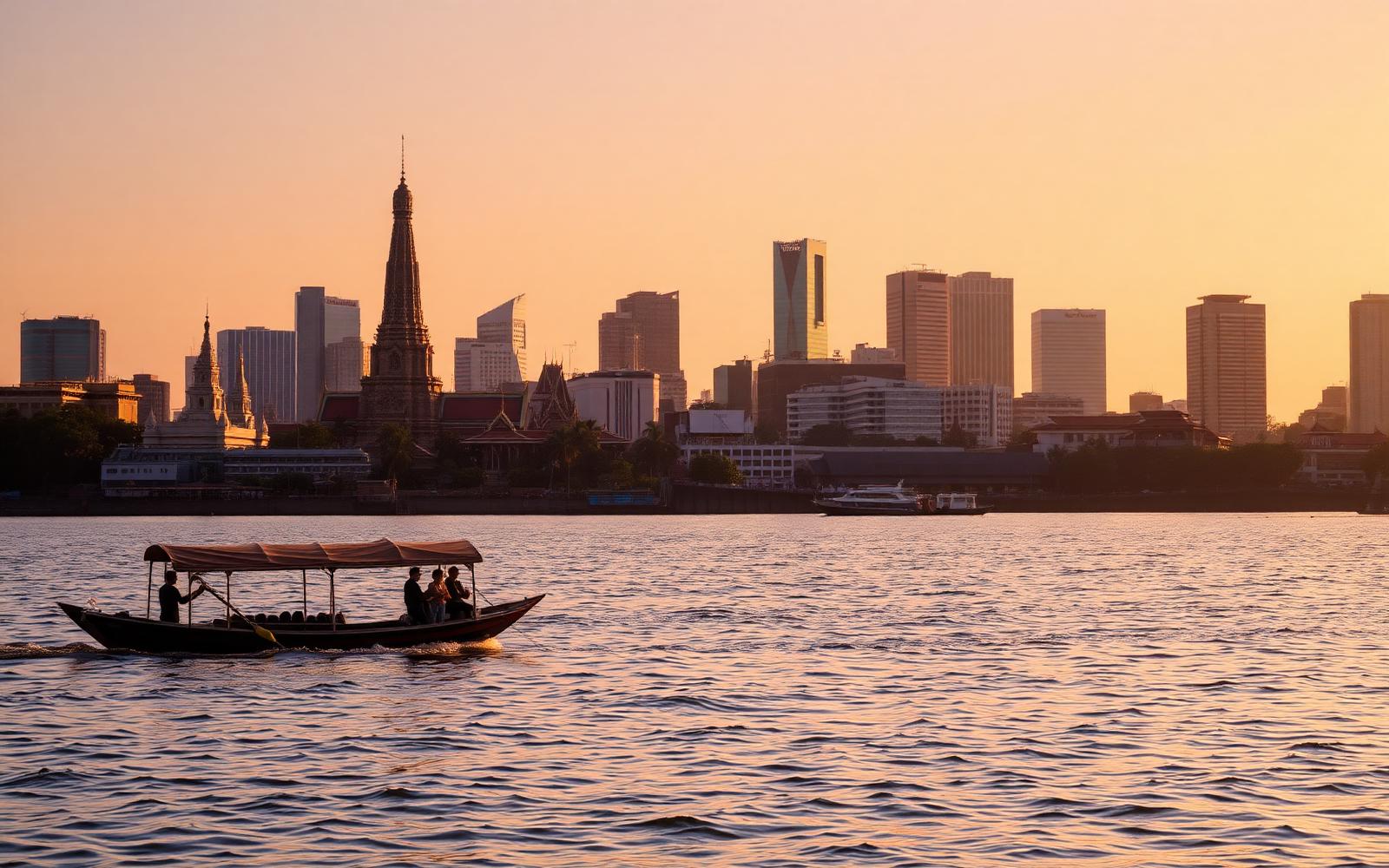
Bangkok skyline at sunset seen from the Chao Phraya river

Bangkok

Thailand's capital and main international gateway: a dense, fast, round-the-clock city where temples, riverside districts, street food and modern rail sit on top of each other.

The verdict

Bangkok is strong for food, culture, nightlife, variety and gateway value — and weaker for effortless calm, compact walkability and beach-led trips.

Bangkok’s heat, humidity, traffic and noise can slow your pace, so allow more time between activities. Air quality may also worsen during parts of the dry season.

Strong for

  • Food, from street stalls to modern kitchens
  • Temples, river heritage and city culture
  • Late-running nightlife and social evenings
  • Variety: you can change the day completely
  • Gateway value for onward Thailand and Asia travel

Weaker for

  • Effortless calm
  • Compact walkability
  • Beach-led trips

What Bangkok actually is

Environment
A vast tropical river city made up of very different districts—not one compact centre.
Energy
Fast, crowded, social and active late into the night, with calmer pockets in selected neighbourhoods.
Purpose
Food, culture, nightlife, shopping, urban exploration and onward travel.
Reality check
Rewarding but demanding. Heat, humidity, traffic, noise, crowds and seasonal air pollution shape the experience.

Decision guide

Arrival and onward connections, food, temples and river heritage, shopping, and long-stay affordability with real city infrastructure.

Hot, humid, low-rise sprawl punctuated by high-rise corridors along the rail lines and the Chao Phraya river.

Distances are longer than a map suggests and road traffic is unpredictable. Plan around the rail lines and the river, not around straight-line distance.

Choose this if

  • You are travelling solo, couples, friends and families.
  • The pace matches you: High and continuous. Streets stay active late; quiet is something you choose a neighbourhood for, not something the city gives you.
  • Your dates fall in January, February, November and December.
  • You would rather not rent a car: public transport here is strong.

Think twice if

  • Sustained heat and humidity cut how much can honestly be done outdoors in one day.
  • Road journeys are unpredictable; anything scheduled off the rail network needs a wide time buffer.
  • Air quality can drop noticeably in the dry months, which matters more the longer the stay.

Getting there and getting around

  • Elevated and underground rail plus river boats cover most visitor needs; road transport is the fallback, not the default.
  • Two international airports and long-distance rail and bus links make it Thailand's main entry and transfer point.
  • Walkability: moderate. Public transport: strong.
  • Flight time and airfare depend on the city you actually start from, not on a default origin.

Who this suits

  • Suits solo, couples, friends and families.
  • some walking required
  • workable with children

Worth comparing with

  • Slower and cooler with a smaller centre, for travellers who find Bangkok's scale and pace too much.
How MTC reached this assessment

This assessment reads the governed record only: decision identity, traveller fit, season values, mobility, recorded drawbacks and the duration-aware cost model (3 cited sources).

Overall confidence recorded for this place: medium. No ratings, reviews or booking inventory are used.

Data last checked: 2026-08-29

Scheduled for recheck after 2027-08-29.

What are you here for?

A trip with a return date: sights, food and one or two districts done properly.

How long?

3 days

Your exact figure is kept as entered — never rounded or grouped into a band.

Examples:

What that costs

Estimated total for 3 days

Budget

$105 – $193

Mid-range

$245 – $455

Premium

$700 – $1,470

Priced using the daily pattern.

Visitor costs: per person, per day, on the ground — accommodation, food, local transport and activities. The first two days include a short-stay and arrival premium.

Excludes international airfare, visas and paperwork, insurance, shopping and anything personal. Estimates only — never a live quote or an availability claim.

Who it suits

  • Travellers who plan their day around eating
  • People who like cities that stay awake
  • First-time or repeat visitors using it as a gateway
  • Long-stayers who want real city infrastructure at a moderate cost

Who it may not suit

  • Anyone whose priority is quiet and slow days
  • Travellers who want to walk everywhere
  • Beach-first trips — the coast is a separate journey
  • People sensitive to heat, humidity or dusty air

Why travellers come

  • Eating is the main event, at every price level.
  • Temples and the river give the city a history you can walk into.
  • Evenings run late without needing a plan.
  • Two international airports make it the easiest place to start or end a trip.

Timing and seasonality

November to February is the cool, drier window and the most comfortable time to be outdoors. March to May is the hottest stretch. Roughly June to October is the wet season, when rain reshapes afternoons rather than whole days. Dry-month air quality is the trade-off for the comfortable weather.

How Bangkok changes through the day and week

A typical day
Mornings are generally better for outdoor sightseeing. Heat builds around midday, while restaurants, markets and nightlife become more active later. The exact pattern changes with the season.
Weekdays
Commuter traffic and business districts are busiest around working hours.
Weekends
Markets, riverside areas, shopping districts and family destinations become busier.

What changes when you stay longer

One month or longer
Accommodation, utilities, laundry, groceries and neighbourhood convenience matter more than sightseeing proximity.
One year or longer
Deposits, insurance, furnishing, administrative requirements and periodic travel become meaningful parts of the budget.

Getting around

Plan around the elevated rail, the underground and the river boats — road traffic is unpredictable and a short map distance can be a long journey. Walking works inside a district, rarely between them.

Elevated and underground rail plus river boats cover most visitor needs; road transport is the fallback, not the default.

Where to stay

Sukhumvit — Asok to Phrom Phong

Dense, international and commercial: malls, clinics, supermarkets and restaurants stacked around the elevated rail.

Directly on the elevated rail with an interchange to the underground at Asok.

Best for: convenience and everyday errands. Strength: everything within one rail stop. Watch out for: street noise, crowded pavements and a less Thai-feeling streetscape.

Silom & Sathorn

Office towers and embassies by day, street food and night markets after work; calmer at weekends.

Both rail lines cross here, with river-boat access at the western end.

Best for: rail access in two directions. Strength: eating well without leaving the district. Watch out for: weekday rush-hour crowding and a quiet, emptier weekend feel.

Riverside & Charoen Krung

The river sets the pace: old shophouses, galleries, hotel terraces and long views at sunset.

River boats plus one rail extension; road journeys inland are slow.

Best for: calm evenings with a view. Strength: the most scenic side of the city. Watch out for: boat timetables ending early and limited late-night returns.

Old Town — Rattanakosin & Banglamphu

Low-rise historic streets, temples, markets and the backpacker corridor; quieter after dark.

River boats and one underground station at the edge; most movement inside the district is on foot.

Best for: temple and heritage days. Strength: the historic city on your doorstep. Watch out for: weak rail coverage, heat with little shade and tourist-priced streets.

Chinatown — Talat Noi & Song Wat

Trade streets and shrines by day, an intense street-food corridor by night, with quiet lanes one street back.

One underground station plus river piers; walking is the practical way around.

Best for: eating. Strength: the densest food streets in the city. Watch out for: night crowds, narrow pavements and traffic fumes.

Siam & Ratchaprasong

The central shopping core: linked malls, walkways above the street and constant movement.

The main elevated-rail interchange, so almost every line is one change away.

Best for: a short trip with a lot to fit in. Strength: unbeatable rail position. Watch out for: crowds, mall-dominated evenings and little residential character.

Ari

Leafy side streets, cafés and small local restaurants; residential and noticeably calmer.

On the elevated rail's northern branch, a short ride from the centre.

Best for: settling in for weeks or months. Strength: everyday calm with rail access. Watch out for: fewer sights nearby and long trips to the old town.

Thonglor & Ekkamai

Design-led restaurants, bars and apartment blocks along long side sois; late-running and social.

Elevated rail on the main road, but the deep side streets need a short ride.

Best for: eating and going out. Strength: the strongest modern dining scene. Watch out for: higher prices and a long walk from the rail into the sois.
Honest trade-offs

  • Great transport on the rail lines, poor transport off them.
  • Endless choice, but decision fatigue and long crossings between districts.
  • Affordable long stays, with heat and air quality as the standing cost.
  • Nightlife energy in the same districts that are loudest to sleep in.
  • Sustained heat and humidity cut how much can honestly be done outdoors in one day.
  • Road journeys are unpredictable; anything scheduled off the rail network needs a wide time buffer.
  • Air quality can drop noticeably in the dry months, which matters more the longer the stay.

Similar places in Thailand

Explore more places in Thailand

Looking beyond Thailand?

These are outside Thailand. Each one is labelled with its own country; those without a page are shown as previews only.

  • Bali Indonesia · IslandPreview onlyIsland living with a bigger long-stay community — page not built yet.

Sources and freshness

Sourced claims cite the Tourism Authority of Thailand, the Thai Meteorological Department and the rail operator. Everything else is an editorial estimate marked as such in the record. Checked 2026-08-29; due for recheck 2027-08-29.

  • Tourism Authority of Thailand — Bangkok2026-08-29
  • Thai Meteorological Department — climate of Thailand2026-08-29
  • BTS Skytrain — network information2026-08-29

Daily ground budget

What one day on the ground costs here, per traveller, with international airfare excluded.