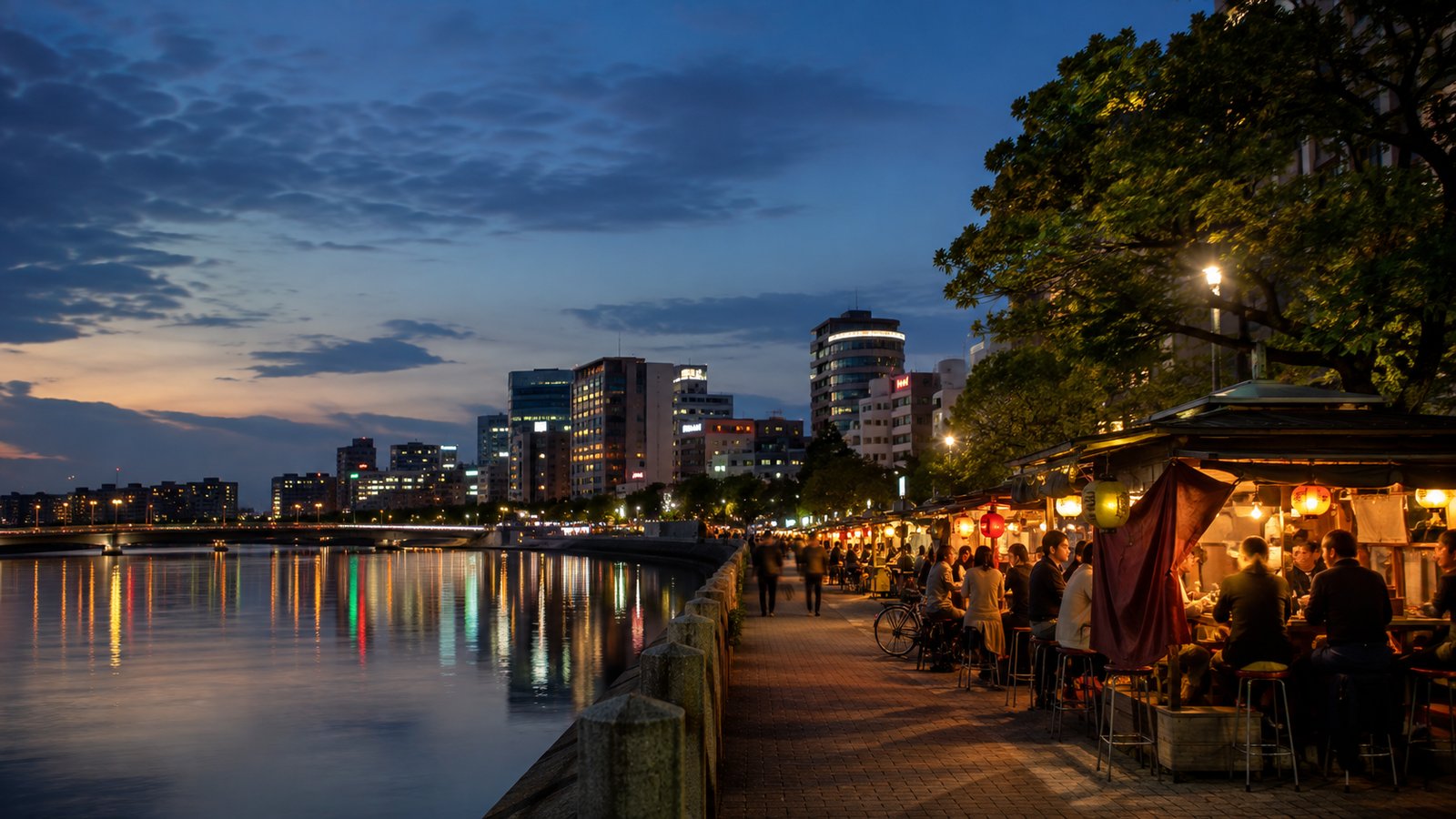
Fukuoka
Choose Fukuoka for a compact, food-first Japanese city with exceptional airport access and easy Kyushu connections; skip it if your priority is iconic temples, megacity scale or a full beach resort.
The verdict
A compact Kyushu gateway that combines historic Hakata, central parks, waterfront districts and one of Japan’s strongest casual-food scenes. Its airport-to-centre connection and manageable scale make it unusually easy for a first or final stop in Japan.
Best for food-led city breaks, first-time Japan visitors who want lower friction, repeat visitors adding Kyushu, solo travelers, couples and travelers using rail for regional day trips.
Strong for
- • Very fast airport access; Hakata food culture and yatai stalls; lively Tenjin and Daimyo; Ohori Park and castle remains; a coastal edge; and efficient connections across Kyushu and onward by Shinkansen.
- • Nature — Medium — strong for parks, bay views and easy coastal excursions, but major wilderness experiences require travel beyond the centre.
- • Beaches — Low to medium — useful for a summer urban-beach day or Itoshima outing, not for a primary tropical-beach holiday.
- • Culture — High — Hakata’s merchant history, shrines, festivals, castle remains and museums give the city depth beyond its modern centre.
- • Food — Very high — tonkotsu ramen, seafood, mentaiko and yatai culture are central reasons to choose Fukuoka.
- • Nightlife — High in Tenjin, Daimyo and Nakasu, with bars, izakaya, live venues and clubs; quieter elsewhere.
- • Meeting people — Medium to high — yatai counters, hostels and compact nightlife make casual interaction easier than in many larger Japanese cities, though language can still limit depth.
- • Wellness — Medium — parks, waterfront walks, public baths and regional onsen day trips support recovery, but wellness is not the city’s dominant identity.
Weaker for
- • It has fewer headline sights than Tokyo or Kyoto; nightlife is concentrated rather than citywide; summer can be hot, humid and wet; and local beaches are seasonal urban escapes, not a substitute for a dedicated island resort.
What Fukuoka actually is
- Environment
- A compact Kyushu gateway that combines historic Hakata, central parks, waterfront districts and one of Japan’s strongest casual-food scenes. Its airport-to-centre connection and manageable scale make it unusually easy for a first or final stop in Japan.
- Energy
- Food and markets; urban culture and temples; parks and waterfront; nightlife; shopping and cafés; baseball/events; Kyushu day trips; seasonal beach and cycling outings.
- Purpose
- Best for food-led city breaks, first-time Japan visitors who want lower friction, repeat visitors adding Kyushu, solo travelers, couples and travelers using rail for regional day trips.
- Reality
- It has fewer headline sights than Tokyo or Kyoto; nightlife is concentrated rather than citywide; summer can be hot, humid and wet; and local beaches are seasonal urban escapes, not a substitute for a dedicated island resort.
What are you here for?
A trip with a return date: the main sights, the food and one or two areas done properly.
How long?
Your exact figure is kept as entered — never rounded or grouped into a band.
What that costs
Estimated total for 3 days
Budget
$198 – $396
Mid-range
$450 – $840
Premium
$975 – $1,830
Priced using the daily pattern.
Visitor estimates cover accommodation, food, local transport and everyday activity. International airfare is excluded. The first days cost more than the settled days: arrival, transfers and orientation are front-loaded.
These are planning estimates from reviewed research, not live prices or availability.
Excluded: international airfare, visas, insurance, shopping and one-off personal costs.
Overview
A compact Kyushu gateway that combines historic Hakata, central parks, waterfront districts and one of Japan’s strongest casual-food scenes. Its airport-to-centre connection and manageable scale make it unusually easy for a first or final stop in Japan.
Ideal travelers
Best for food-led city breaks, first-time Japan visitors who want lower friction, repeat visitors adding Kyushu, solo travelers, couples and travelers using rail for regional day trips.
Reasons to go
- Very fast airport access; Hakata food culture and yatai stalls; lively Tenjin and Daimyo; Ohori Park and castle remains; a coastal edge; and efficient connections across Kyushu and onward by Shinkansen.
Limitations and watch-outs
- It has fewer headline sights than Tokyo or Kyoto; nightlife is concentrated rather than citywide; summer can be hot, humid and wet; and local beaches are seasonal urban escapes, not a substitute for a dedicated island resort.
Recommended stay
3–5 nights for the city; 5–7 nights if using Fukuoka as a base for Dazaifu, Itoshima, Yanagawa or wider northern Kyushu.
Seasons
April–May and October–November usually offer the best balance of mild weather and walkability. March can work for spring atmosphere, while bloom timing varies annually. June–July bring the main rainy-season risk; July–August are hot and humid; late summer into early autumn can face typhoon disruption. Golden Week and major festival dates can tighten availability.
Arrival and local transport
Fukuoka Airport is the primary gateway. The domestic terminal connects directly to the city subway; the airport is about six minutes from Hakata Station by subway. International-terminal passengers use the inter-terminal shuttle before joining the subway network.
The subway covers the airport, Hakata, Nakasu, Tenjin and western districts; JR and Nishitetsu trains extend regional reach. Walking works well within each central district, while buses fill gaps. Official route data should be checked for late-night travel.
Areas and bases
Hakata for transport and practical first stays; Tenjin/Daimyo for dining, cafés and nightlife; Nakasu-Kawabata for riverfront evenings and yatai access; Ohori/Akasaka for calmer park-side stays; Momochi for waterfront space but less late-night convenience.
Experiences
Food and markets; urban culture and temples; parks and waterfront; nightlife; shopping and cafés; baseball/events; Kyushu day trips; seasonal beach and cycling outings.
What it is strong for
Nature — Medium — strong for parks, bay views and easy coastal excursions, but major wilderness experiences require travel beyond the centre.
Beaches — Low to medium — useful for a summer urban-beach day or Itoshima outing, not for a primary tropical-beach holiday.
Culture — High — Hakata’s merchant history, shrines, festivals, castle remains and museums give the city depth beyond its modern centre.
Food — Very high — tonkotsu ramen, seafood, mentaiko and yatai culture are central reasons to choose Fukuoka.
Nightlife — High in Tenjin, Daimyo and Nakasu, with bars, izakaya, live venues and clubs; quieter elsewhere.
Meeting people — Medium to high — yatai counters, hostels and compact nightlife make casual interaction easier than in many larger Japanese cities, though language can still limit depth.
Wellness — Medium — parks, waterfront walks, public baths and regional onsen day trips support recovery, but wellness is not the city’s dominant identity.
Traveler suitability
Solo — High — compact, transit-friendly and easy to dine alone; normal urban awareness still applies after dark.
Couple — High — food, waterfront evenings, parks and coastal day trips create varied low-friction days.
Family — High — convenient transport and family attractions work well, though small rooms and late-night entertainment streets require planning.
Accessibility
Major stations and the airport provide step-free facilities, but older shops, yatai and small restaurants may be tight or stepped. Confirm elevator exits, room dimensions and accessible toilets for each itinerary.
Risks, scams and etiquette
Main practical risks are entertainment-district touts or bill disputes, misplaced belongings, heat, heavy rain and transport disruption rather than organized tourist scams. Avoid following unsolicited touts and verify menu prices.
Keep voices low on transit, queue carefully, do not tip by default, follow shrine rules, and ask before photographing food-stall staff or other guests. Some baths restrict visible tattoos.
Remote-work practicality
High — urban mobile coverage, hotel Wi‑Fi, cafés and station facilities are generally strong. Verify upload speed, desk quality and quiet-room requirements with the property; yatai and nightlife districts are poor work bases.
Planning estimates
Estimates only. These are editorial planning ranges, not live prices, availability or quotes.
Daily estimate — budget — $66–$132 USD · Solo traveler; dorm/capsule or basic room, convenience-store/simple meals, subway/walking, mostly free sights.
Daily estimate — mid-range — $150–$280 USD · Solo traveler in a well-rated business hotel, mixed casual dining, regular transit and several paid experiences.
Daily estimate — comfortable — $325–$610 USD · Upscale central hotel, restaurant dining, occasional taxis and paid day trips; peak events can exceed the range.
30-day estimate — $2410–$6050 USD · One person, 30 nights, monthly apartment or extended-stay/business-hotel rate where available, mostly local meals, urban transit, four to eight paid outings, no international airfare.
Alternatives to consider
Osaka — Choose for a larger food-and-nightlife city with broader Kansai day trips.
Hiroshima — Choose for modern-history depth and Miyajima access at a calmer scale.
Kyoto — Choose for temples, gardens and heritage density rather than airport ease and casual food culture.
Busan — Comparable compact port-city energy, seafood and beaches; confirm inventory identity before linking.
Taipei — Comparable food-first city break with easy transit and day trips; confirm inventory identity.
Seoul — Choose for much greater scale, shopping and nightlife; higher intensity and longer transfers.
Source ledger
checked 2026-09-02 · recheck after 2026-10-02
- Fukuoka City — Japan National Tourism Organization · primary · 2026-08-30 · volatility: low
- Fukuoka City Area Guide — Fukuoka City Official Tourist Guide · primary · 2026-08-30 · volatility: medium
- Fukuoka Airport subway access — Fukuoka Airport · primary · 2026-08-30 · volatility: high
- Fukuoka City Subway route map — Fukuoka City Transportation Bureau · primary · 2026-08-30 · volatility: high
- Climatological Normals 1991–2020 — Japan Meteorological Agency · primary · 2026-08-30 · volatility: low
- Fukuoka hotel-price analysis — Budget Your Trip · secondary · 2026-08-30 · volatility: high
- Accessibility services — Fukuoka Airport · primary · 2026-08-30 · volatility: medium
- Japan travel guidance — U.S. Department of State · government_advisory · 2026-08-30 · volatility: very-high
- Airport work booth — Fukuoka Airport · primary · 2026-08-30 · volatility: high
Similar places in Japan
- Tokyo — CityYou gain: Unmatched rail coverage, safety, food depth and four real seasonsYou give up: Low prices, small rooms stay small, and beach or tropical warmth
- Kyoto — CityYou gain: Japan's densest heritage, gardens, craft and preserved streets on footYou give up: An airport of its own, crowd-free famous sights, step-free routes and late nights
- Osaka — CityYou gain: Choose Osaka for food, nightlife and an easy Kansai base with a friendlier street rhythm than Tokyo.You give up: Central zones are convenient, but stations are large and summer humidity is tiring.
- Nara — CityYou gain: Choose Nara for temples, parkland and a focused heritage stay that is calmer and more compact than Kyoto.You give up: You gain calm and concentration but give up Kyoto’s breadth, nightlife and long-stay variety.
- Nikko — TownYou gain: See the Nikkō UNESCO shrines and temples, including richly decorated Tōshōgū, in a forest setting. Combine culture with Lake Chūzenji, Kegon Falls and the landscapes of Nikkō National Park. Reach a very different environment from central Tokyo in roughly two hours by rail.You give up: Temple approaches, slopes, stairs and natural trails can be difficult for travelers with limited mobility. Buses to the lake and higher areas can be slow or crowded at autumn-color peaks. Evenings are quiet and many sights close earlier than in a major city.
Explore more places in Japan
- TokyoVast, orderly capital of distinct districts, run by trains
- KyotoWalkable heritage city of temples and gardens, hemmed by hills
- OsakaLively, food-led and less formal than Tokyo.
- NaraQuiet, reflective and walkable, with daytime visitor surges around the park.
- NikkoNikko suits travelers who want major heritage and mountain nature within easy reach of Tokyo, provided they accept buses, slopes and weather-sensitive plans.
Looking beyond Japan?
These are outside Japan. Each one is labelled with its own country; those without a page are shown as previews only.
- Bangkok — Thailand · CityYou gain: Widest choice of food, transport, hospitals and flightsYou give up: Quiet, clean air and easy nature access
- Chiang Mai — Thailand · CityYou gain: Lower monthly costs, cooler months and nature within an hourYou give up: Beaches, big-city variety and the smoke-free burning season
- Phuket — Thailand · IslandYou gain: Sea access every day and the widest resort choice in the southYou give up: Lower daily costs and calm during the high season
- Dubai — United Arab Emirates · CityYou gain: A warm, dry winter sea, easy arrival, onward flights and reliable everyday infrastructureYou give up: Walkable districts, a bearable summer, old-city character and low transport costs
- Cairo — Egypt · CityYou gain: Giza and Saqqara, a thousand years of Islamic and Coptic architecture, real city culture and very low pricesYou give up: Short distances, clean air, quiet nights, step-free access and any summer outdoor plan
- Luxor — Egypt · CityYou gain: The densest ancient Egyptian archaeology anywhere, walkable temples and a slow riverYou give up: City life, shade, a bearable summer and anything that is not archaeology or the Nile
- Hanoi — Vietnam · CityYou gain: Strong food culture, compact central exploration and lower everyday costsYou give up: Quiet traffic, easy crossings and consistently clean air
- Ho Chi Minh City — Vietnam · CityYou gain: Deep food choice, social energy and strong regional connectivityYou give up: Calm streets, cool weather and a compact city footprint
- Da Nang — Vietnam · CityYou gain: Beach access with a more manageable urban scale and central Vietnam reachYou give up: Megacity variety and a fully mature long-stay ecosystem
- Ubud — Indonesia · TownYou gain: Dense wellness options, creative culture and easy access to rice-field sceneryYou give up: Beach access, uncongested roads and big-city infrastructure
- Madrid — Spain · CityYou gain: Major cultural institutions, rail connectivity and strong everyday city lifeYou give up: Sea access and a mild peak-summer climate
- Mexico City — Mexico · CityYou gain: Exceptional food, museums and urban variety at broad price pointsYou give up: Short travel times, simple air-quality planning and low-altitude ease
- Valencia — Spain · CityYou gain: Beach-city combination, cycling potential and a calmer scale than Madrid or BarcelonaYou give up: Capital-city breadth and the largest international flight network
- Amsterdam — Netherlands · CityYou gain: Walkable and bikeable districts, strong rail links and major museumsYou give up: Low accommodation costs, abundant space and crowd-free central streets
- Buenos Aires — Argentina · CityYou gain: Neighbourhood depth, cultural life and strong value for longer staysYou give up: Economic predictability and short international travel from most regions
- Kuala Lumpur — Malaysia · CityYou gain: Good regional flights, diverse halal food and strong urban convenienceYou give up: Cool weather, continuous walkability and a compact historic centre
- Abu Dhabi — United Arab Emirates · CityYou gain: Choose Abu Dhabi for museums, beaches and polished Gulf comfort at a calmer pace than Dubai.You give up: You gain space and calm but give up compact walkability and Dubai-level nightlife.
- Seoul — South Korea · CityYou gain: Choose Seoul for design, food, nightlife and efficient big-city variety across distinct neighborhoods.You give up: You gain range and convenience but spend time crossing a very large city.
- Busan — South Korea · CityYou gain: Choose Busan for beaches, seafood and a more relaxed Korean city rhythm backed by excellent urban transport.You give up: Coastal beauty comes with long distances between Haeundae, Seomyeon and Nampo.
- Singapore — Singapore · CityYou gain: Choose Singapore for effortless transport, exceptional food diversity and a clean, safe introduction to Southeast Asia.You give up: You gain reliability and range but lose low-cost spontaneity and cooler weather.
- Lisbon — Portugal · CityYou gain: Choose Lisbon for light, viewpoints, social neighborhoods and Atlantic access in a compact capital.You give up: You gain atmosphere and coast access but accept hills, crowds and expensive central rentals.
- Porto — Portugal · CityYou gain: Choose Porto for river scenery, compact historic character and a slower, often better-value Portuguese city stay.You give up: The centre is compact but physically demanding, and wet weather changes the experience.
- Paris — France · CityYou gain: Choose Paris for unmatched museum depth, walkable neighborhoods and a cultural calendar that rewards repeat visits.You give up: You gain extraordinary depth but pay for space and spend time on queues and transfers.
- Barcelona — Spain · CityYou gain: Choose Barcelona for architecture, beach access and late Mediterranean city life in one compact trip.You give up: You gain sea and city variety but share the core with heavy visitor demand.
- Rome — Italy · CityYou gain: Choose Rome for unmatched ancient layers, neighborhood food and a cityscape where everyday life meets monuments.You give up: The reward is extraordinary depth; the price is friction, crowds and tiring surfaces.
- Florence — Italy · CityYou gain: Choose Florence for Renaissance art, compact walking and Tuscan day trips from one beautiful base.You give up: Everything is close, but queues and visitor density can make the compactness feel compressed.
- Vienna — Austria · CityYou gain: Choose Vienna for museums, music and exceptionally reliable public transport in an elegant, liveable capital.You give up: You gain ease and quality but pay more and encounter a less improvised social rhythm.
- Prague — Czechia · CityYou gain: Choose Prague for dramatic historic streets, excellent transit and strong value relative to Western European capitals.You give up: You gain beauty and transport ease but must avoid crowd traps and steep tourist pricing.
- Athens — Greece · CityYou gain: Choose Athens for ancient history, energetic street life and fast access to the Athenian Riviera and islands.You give up: You gain history and value but accept heat, rough surfaces and pockets of urban disorder.
- Istanbul — Türkiye · CityYou gain: Choose Istanbul for layered imperial history, exceptional food and ferry-linked neighborhoods across two continents.You give up: You gain extraordinary variety but spend energy on crowds, slopes, transfers and traffic.
- Rio de Janeiro — Brazil · CityYou gain: Choose Rio for world-class urban beaches, mountain scenery and an outdoor social energy unlike any other major city.You give up: The beauty is exceptional, but heat, distances and security planning add daily friction.
- Oaxaca — Mexico · CityYou gain: Choose Oaxaca for exceptional regional food, Indigenous culture and a walkable historic centre backed by craft villages and archaeology.You give up: The centre is easy, but heat, altitude, festival demand and regional transport shape the trip.
- Canggu — Indonesia · TownYou gain: Choose Canggu for surf, cafés, coworking and easy social connection in Bali’s busiest long-stay beach hub.You give up: You gain community and convenience but trade away calm roads, walkability and local texture.
- Koh Samui — Thailand · IslandYou gain: Choose Koh Samui for the easiest full-service Thai island stay, with beaches, an airport and broad accommodation choice.You give up: You gain island convenience but pay more and depend on taxis, drivers or a properly licensed rental.
- Koh Phangan — Thailand · IslandYou gain: Choose Koh Phangan for a more independent Thai island stay mixing beaches, wellness, community and periodic party intensity.You give up: You gain community and quieter bays but accept ferry dependence, steep roads and event volatility.
- Krabi — Thailand · GatewayYou gain: Choose Krabi for limestone scenery, island day trips and a calmer Andaman base than Phuket.You give up: You gain dramatic nature and lower intensity but depend on boats, taxis and seasonal sea conditions.
- Hoi An — Vietnam · TownYou gain: Choose Hoi An for preserved streets, food, tailoring and an easy blend of town, countryside and beach.You give up: You gain charm and easy variety but accept tourism pressure and weather-sensitive river conditions.
- Pattaya — Thailand · CityYou gain: Choose Pattaya for easy Bangkok access, broad accommodation value and high-energy coastal entertainment.You give up: You gain convenience and value but trade away pristine beaches and subtle local atmosphere.
- Taipei — Taiwan · CityYou gain: Choose Taipei for night markets, excellent transit and easy access to green mountains from a friendly, manageable capital.You give up: You gain convenience and nature access but accept persistent humidity and frequent rain.
- Manama — Bahrain · CityYou gain: Choose Manama for a compact Gulf stop combining heritage, dining, business access and quick island-wide excursions.You give up: You gain compact regional access and value, but walking is limited and major sights are spread across Bahrain.
- London — United Kingdom · CityYou gain: Choose London for unmatched museums, neighbourhood variety and global connectivity when budget and travel time are flexible.You give up: You gain scale and choice but give up low costs, compactness and spontaneous cross-city movement.
- Milan — Italy · CityYou gain: Choose Milan for design, fashion, food and efficient northern-Italy connections rather than Italy’s deepest concentration of ancient sights.You give up: You gain efficiency and contemporary energy but give up Rome’s archaeological depth and broader historic spectacle.
- Copenhagen — Denmark · CityYou gain: Choose Copenhagen for design, cycling and calm waterfront neighbourhoods when quality and ease matter more than low prices.You give up: You gain safety, order and effortless urban movement but give up affordability and late-night intensity.
- Kaohsiung — Taiwan · CityYou gain: Choose Kaohsiung for warmer weather, harbour culture and better value than Taipei, with a slower southern rhythm.You give up: You gain space, warmth and lower costs but give up Taipei’s job market, scale and northern connections.
- Marrakech — Morocco · CityYou gain: Choose Marrakech for intense markets, riad atmosphere and easy Atlas access when sensory energy matters more than calm navigation.You give up: You gain atmosphere and variety but give up low-friction wayfinding, quiet streets and consistent pricing.
- Fes — Morocco · CityYou gain: Choose Fes for Morocco’s most absorbing medieval urban fabric, traditional craft and a slower cultural stay.You give up: You gain historic depth and authenticity but give up easy orientation, broad nightlife and resort convenience.
- Cape Town — South Africa · CityYou gain: Choose Cape Town for exceptional mountain-and-ocean scenery, food and varied day trips, with deliberate safety and transport planning.You give up: You gain world-class variety but give up frictionless public transport and carefree movement in every area after dark.
- Johannesburg — South Africa · CityYou gain: Choose Johannesburg for contemporary African culture, business and regional connections, not for an easy conventional sightseeing break.You give up: You gain cultural depth and regional reach but give up easy independent wandering and scenic urban cohesion.
- New York City — United States · CityYou gain: Choose New York for maximum culture, food and urban energy when cost, noise and constant choice are acceptable tradeoffs.You give up: You gain unmatched density and possibility but give up space, quiet and budget predictability.
- Boston — United States · CityYou gain: Choose Boston for compact American history, universities and walkable neighbourhoods at a calmer scale than New York.You give up: You gain walkability and focus but give up New York’s scale, late-night range and price-to-choice ratio.
- Los Angeles — United States · CityYou gain: Choose Los Angeles for film culture, food diversity, beaches and creative neighbourhoods when driving and distance are acceptable.You give up: You gain extraordinary range but give up compactness, predictable journey times and easy spontaneous movement.
- San Francisco — United States · CityYou gain: Choose San Francisco for dramatic hills, bay scenery, food and compact neighbourhood variety, despite very high costs.You give up: You gain extraordinary scenery and walkable clusters but give up affordability, flat routes and consistent street conditions.
- Cancún — Mexico · Resort zoneYou gain: Choose Cancún for easy resort beaches, strong flight access and packaged convenience, not for deep independent city life.You give up: You gain convenience and beach quality but give up local texture, walkable variety and stable peak pricing.
- Playa del Carmen — Mexico · Resort zoneYou gain: Choose Playa del Carmen for a walkable Riviera Maya base with beach access and easy regional trips, accepting rapid development.You give up: You gain walkability and regional freedom but give up quiet, pristine urban beaches and consistent value.
- Lima — Peru · CityYou gain: Choose Lima for world-class food, Pacific neighbourhoods and Peru connections, not for postcard weather or compact sightseeing.You give up: You gain culinary depth and value but give up easy cross-city movement, sun certainty and visual cohesion.
- Cusco — Peru · CityYou gain: Choose Cusco for concentrated Andean and colonial heritage plus Sacred Valley access, with altitude and crowds planned carefully.You give up: You gain exceptional history and landscape but give up sea-level ease, stable weather and low visitor density.
- Bogotá — Colombia · CityYou gain: Choose Bogotá for major museums, highland culture, food and business depth, with traffic, altitude and safety planning.You give up: You gain capital-city depth and value but give up easy mobility, tropical warmth and low-friction street movement.
- Medellín — Colombia · CityYou gain: Choose Medellín for mild weather, mountain neighbourhoods and an easy longer-stay rhythm, while planning safety and visitor impact.You give up: You gain climate, value and routine but give up carefree nightlife movement and insulation from overtourism effects.
- Sydney — Australia · CityYou gain: Choose Sydney for iconic harbour scenery, beaches and strong urban convenience when high costs and distance are manageable.You give up: You gain scenery, safety and infrastructure but give up affordability, proximity to other world regions and compact scale.
- Melbourne — Australia · CityYou gain: Choose Melbourne for food, arts, sport and neighbourhood life when urban culture matters more than iconic harbour scenery.You give up: You gain neighbourhood depth and cultural routine but give up Sydney’s harbour spectacle and reliable beach weather.
- Sharm El Sheikh — Egypt · Resort zoneYou gain: Choose Sharm El Sheikh for resort ease, clear-water diving and winter sun when local city depth is not the priority.You give up: You gain coral access and resort convenience but give up urban variety, independent mobility and deep local texture.
- Hurghada — Egypt · Resort zoneYou gain: Choose Hurghada for accessible Red Sea resorts, diving and mainland excursions with more town life than Sharm.You give up: You gain value and regional access but give up compactness, polished consistency and dramatic Sinai scenery.
- Budapest — Hungary · CityYou gain: Choose Budapest for thermal baths, grand river scenery and strong value in a culturally rich, nightlife-friendly capital.You give up: You gain beauty and value but give up Prague’s compact fairy-tale core and Vienna’s polished museum infrastructure.
- Antalya — Türkiye · CityYou gain: Choose Antalya for Mediterranean beaches, a historic old town and easy resort-region access with strong shoulder-season value.You give up: You gain climate, value and coast access but give up Istanbul’s cultural scale and compact access to the whole resort region.
- Hua Hin — Thailand · Resort zoneYou gain: Reach a beach-resort base overland from Bangkok without a flight or island ferry. Combine beach time with night markets, food, spas, golf and nearby nature trips. Choose among central, market-oriented and quieter southern bases for short or extended stays.You give up: The beach is convenient rather than Thailand’s most dramatic tropical coast. The city is spread out; crossing the main road and reaching outer attractions often requires songthaews, taxis or a car. Heat, humidity and seasonal rain can reduce daytime comfort.
- Bali — Indonesia · IslandPreview onlyIsland living with a bigger long-stay community — page not built yet.
Sources and freshness
Planning guidance checked 2026-09-02; verify prices, schedules, entry rules and local conditions before booking.
- Fukuoka City — 2026-09-02
- Fukuoka City Area Guide — 2026-09-02
- Fukuoka Airport subway access — 2026-09-02
- Fukuoka City Subway route map — 2026-09-02
- Climatological Normals 1991–2020 — 2026-09-02
- Fukuoka hotel-price analysis — 2026-09-02
- Accessibility services — 2026-09-02
- Japan travel guidance — 2026-09-02
- Airport work booth — 2026-09-02
Daily ground budget
What one day on the ground costs here, per traveller, with international airfare excluded.